Posted on Leave a comment

How to Write a Horror Novel: Tips for Scary Scenes

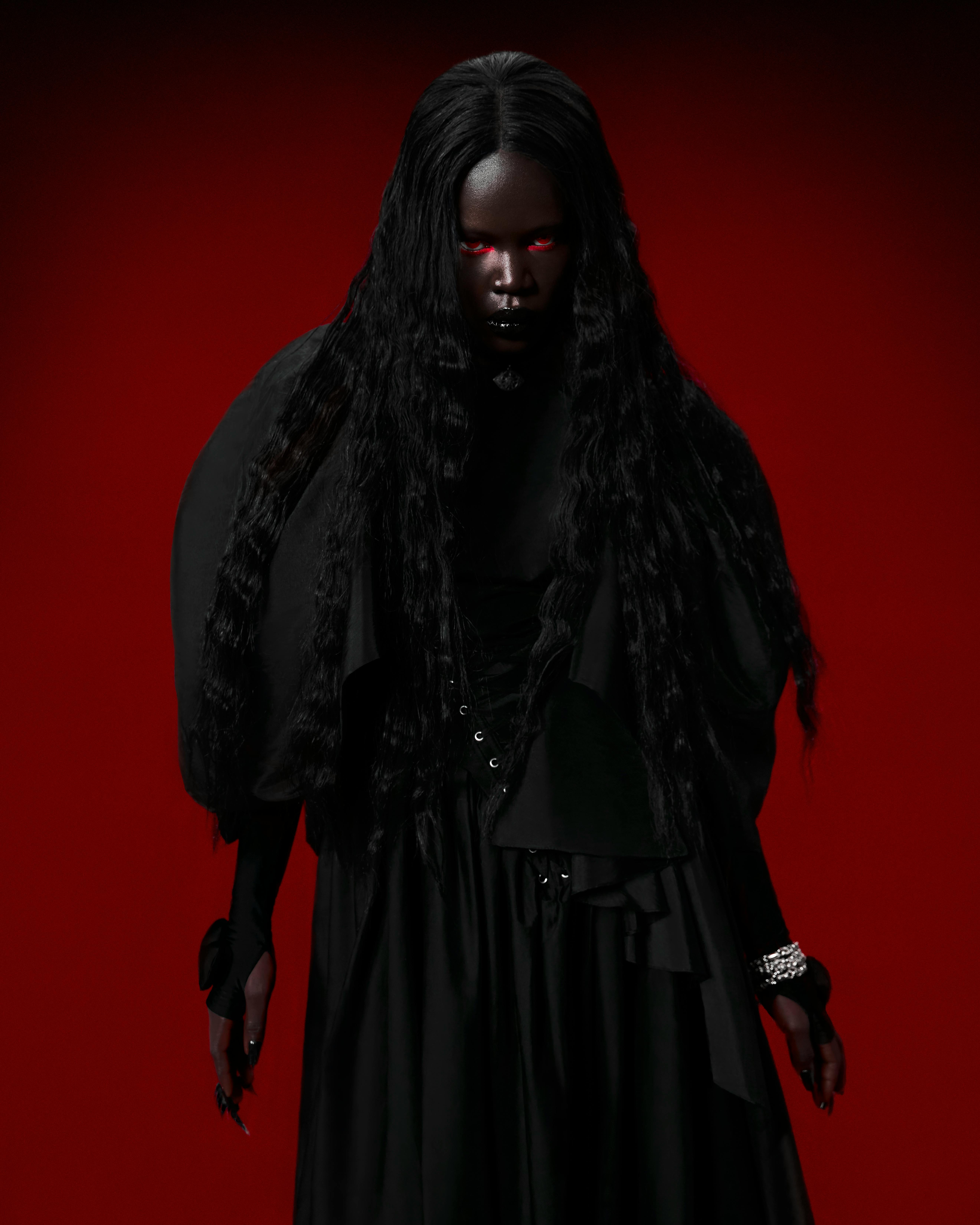
A dark-skinned woman with red eyes wearing all black on a red background stares menacingly into the camera.

Leave your readers with a proper fright after finishing your unnerving tale.

You’re writing your horror book, and everything is coming together nicely: The characters have depth and intriguing backstories; you’ve staked out a creepy setting; and your stalker, monster, cosmic entity, killer inanimate object, etc., is iconic and menacing. You have the components of a great story, yet can’t help but feel that something is missing. You begin to question if you know how to write a horror novel, until you read your manuscript, and only then does it hit you. You don’t feel… scared.

A spider on its web against a dark background with boca effect
Photo by kaboompics. Pexels.

The Importance of a Scare in Horror Story Writing

A well-constructed scare is as important as characters, setting, and plot in horror story writing. It adds bitter flavor, lingering with your readers long after they’ve flipped through the pages. Every ominous shadow in the corners of any room they walk into, strange bumps and thuds in the night, everyday objects that typically don’t frighten them—all because your book left a lasting impact. Tending to your scares with the love and care they deserve keeps your book faithful to the horror genre, and more importantly, makes your book memorable.

I previously compiled a list of excellent horror novel recommendations with bone-chilling scares that you may find useful!

Tip #1 to Write Horror: Find Your Subgenre

Before you begin sprinkling in jump scares or passages of shock and gore, consider the subgenre of your horror book, as each has its own types of scares. A paranormal story relies more heavily on suspense and unease, whereas a slasher leans into jump scares and bloodshed to frighten the reader. If you are struggling to pinpoint your subgenre, consider the following types of horror:

  • Paranormal: events, activities, and entities not scientifically explainable, e.g., ghosts or telekinesis 
  • Psychological: relating to the protagonist’s mind
  • Slasher: a killer or entity preying on a group of people
  • Gore and body horror: concerned with extreme violence and visceral experience
  • Monster: a creature or one’s transformation into one, e.g., werewolves, vampires, zombies

This article covers a more extensive list breaking down these subgenres further, but these are the broad ones worth considering for the sake of this process.

Tip #2 to Write Horror: Harness Fears Effectively

Now that you’ve identified your subgenre, we can look at the different types of fear. Each stroke of horror utilizes different fears, including fear of Death, fear of the loss of sanity, fear of loss of loved people or culture, or fear of pain. 

Consider two classics: Psycho, written by Robert Bloch, utilizes suspense and sudden violence to startle readers in small bursts, whereas The Shining, written by Stephen King, uses the same suspense to establish dread and anxiety that prolongs until erupting into chaos in its final pages. 

These two books reveal different approaches for how to write a horror novel by relying on different types of fear to frighten their readers. It’s crucial to have a solid understanding of your subgenre to know what fears work best. For example, a gore book sustaining the same suspense as The Shining won’t be as effective as one that prioritizes shock and disgust. (For more on how to use a fear of Death in horror story writing, check out this blog.) 

A young Black woman holds open a book and appears engaged with the text.
Photo by Ron Lach. Pexels.

It’s also worth cozying up with similar books and noting their structure. A suspenseful story may involve leaving a trail of unease throughout, and thus requires a different editing approach than a book with quickly established jump scares. That’s not to undermine the importance of maintaining an eerie atmosphere regardless of subgenre (which can be expertly curated utilizing mood boards), but rather to emphasize how scares are catered to differently in horror stories. A revision of your book centered on incorporating these fears can prove useful to heighten the effectiveness of your book. 

Tip #3 to Write Horror: Consider POV

Lastly, and this may sound surprising, but the point-of-view you choose to write your book in greatly matters in how you approach writing scenes that genuinely feel scary. 

First-Person POV

A first-person POV puts readers in the shoes of the narrator, and thus, they can only visualize the narrator’s senses. Curating surprises may be more effective if it focuses on the character’s sudden reaction and feelings toward a scare, told from their perspective. A psychological horror book can utilize confusion to scare readers. You can lean into what the narrator sees and feels that may be abstract or out-of-the-ordinary to play with the reader’s mind, especially if the narrator themselves doesn’t recognize it as peculiar. 

Third-Person POV

Despite the story not unfolding through the narrator’s eyes, a third-person POV can be effective in staging sudden scares or odd occurrences, while also describing the world outside of a character’s immediate view. Great for suspense, a third-person POV allows you to focus on an object or threat that is approaching a character without their knowledge. A monster lurking in the shadows or a ghost appearing on a monitor when someone looks away: A third-person POV is excellent at staging the world outside a character’s direct experiences. 

Even… Second-Person POV?

An excellent example of POV manipulation in horror story writing is in The Only Good Indians, written by Stephen Graham Jones. (Minor spoilers ahead!) The book is mainly written in the third-person, following a group of hunters tracking a monster. In one instance, a character is scanning his surroundings with a gun when he lands on someone, you, the reader, now addressed in the second-person as the monster they’ve been hunting. It’s a masterful example of producing a scare by exploiting POV before the reader can fully comprehend what’s happening. 

If you’re looking for more effective frights, I previously compiled a list of some excellent horror novels with bone-chilling scares!

Map Out and Curate Your Scares

Once you understand your subgenre, its associated fears, and identify your POV, you can begin to establish your scares. There is an extensive list of tips from published writers on what they utilize to startle their audience, and reading other horror books and identifying what about them scares you will inspire you to implement the same techniques when you write horror

Scare Trope Example No. 1: Horrifying "Safe" Spaces

Consider including scares in otherwise-safe spaces. Vividly describing a derelict house or abandoned hospital can be equally valuable in building suspense and unease. Think of Jaws and how the novel (by Peter Benchley) and film (by Steven Spielberg) made an entire generation afraid to swim at the beach, or how the film The Ring (based on Japanese horror novel, Ring, by Koji Suzuki)  recontextualized water wells and TVs as things/spaces to be afraid of. 

Scare Trope Example No. 2: The Unlikely Threat

Another example of a common scare type is an unlikely threat. It could be argued that The Omen (screenplay by David Seltzer) or Children of the Corn (again by Stephen King) largely contributed to a trope in horror involving unease toward children. We assume them unlikely to be a threat, only to be confronted with how horrifying they truly are. Or, how a film like Child’s Play or a novel like How to Sell a Haunted House (by Grady Hendrix) instil in viewers a lurking fear that prompts them to keep their eyes on inanimate dolls…just in case they spring to life. 

Toying with the unordinary and even looking inward at what scares you personally are excellent ways to construct a memorable scare that surprises the reader. You can defy expectations or lean into what already unsettles you and people like you. 

Final Thought About How to Write a Horror Novel

A dark-skinned woman with red eyes wearing all black on a red background stares menacingly into the camera.

A horror book can have intricately written characters or a unique plot, but if it’s not scary (or even suspenseful), readers will feel disappointed. Hopefully, you now feel more confident on how to write a scary scene in your horror novel or short story; hopefully you feel prepared to unnerve and surprise your readers. My final piece of advice for how to write a horror novel is to remember that it is okay to revise and edit until you feel confident your scares are effective. Horror readers love nothing more than the excitement of fear and unease creeping into their daily lives after reading an effective, frightening spine-tingler. Family, friends, colleagues, and professional beta readers can provide valuable feedback that helps you identify what didn’t work and what needs a bit more to really get readers’ hearts racing and keep them up at night.

Ready to speak with an editor about your horror novel?

Posted on 1 Comment

Editor’s Advice for Writing a Novel: How to Write the Hero’s “Ordeal”

A broken ladder leads up a stiff cliff; advice for writing the Ordeal in your novel

Emotionally compelling protagonists are at the heart of the best advice for writing a novel.

“If you want to be a writer, you have to be a reader.” So the advice for writing a novel typically goes. And this advice remains solid because there are many things writers can learn by example from exposure to other people’s stories and storytelling. 

If you’ve ever read a book, watched a movie or TV show, or played a video game, you’ve engaged with the story structure known as the Hero’s Journey (possibly even without knowing it, although if you have a background in creative writing, this will sound familiar). The Hero’s Journey is a twelve-step narrative structure from Joseph Campbell in his book of the same name, a structure that most conventional fiction follows. These steps span all three acts of the story, beginning with Ordinary World (the introduction to the setting) and ending with Return With The Elixir (the hero returning to their world, triumphant after completing their task or facing their challenge). 

Diagram of the Hero's Journey
Image by Wikimedia.

 (*also: please note: I intend and use “hero” in a gender-neutral way and interchangeably with “protagonist” throughout this blog.)

If you’re not familiar, or you want a refresher, take a look at the Hero’s Journey structure, and you will think of examples from the hundreds of stories you know. There’s a ton of guidance out there that addresses different steps in the Journey; in this blog, I’d like to focus my advice for writing a novel on the Eighth Step, the Ordeal, which is generally considered one of the most important moments in the conclusion of your story.

Exploring the Eighth Step: The Ordeal

A broken ladder leads up a stiff cliff; advice for writing the Ordeal in your novel
Photo by Théo Cold, Pexels.

The eighth step, The Ordeal, is described as the lowest point of the protagonist at the end of act two. It is their dramatic downfall or defeat, but it also reveals the truth of their character. Maybe the hero lost a battle against the villain, or they failed to save another character from danger. This step sees the protagonist hitting rock bottom in order to return with greater strength and resolve to conquer the main antagonist or conflict. (Not to be confused with the eleventh step, The Resurrection, which is defined as the final confrontation or climax, in book terminology.) 

Define Your Protagonist: Advice for Writing a Novel Lead

When you’re outlining your story or reach The Ordeal when writing, it can be challenging to weave plot points and character arcs together to create an emotional downfall for your protagonist. However, effectively crafting your protagonist makes this step easier to define through the following traits: their goal, their room for improvement, and their inner turmoil. If you find yourself struggling to define your character or build the right emotional tension, Developmental Editing provides that kind of assistance on your book’s character work and overall structure.

#1: What Are Your Protagonist’s Strengths and Goals?

After The Ordeal, ask yourself and outline: 

What strengths does your protagonist currently hold? And what do they still hope to accomplish? 

Return to your story and make note of the knowledge your protagonist currently has after their loss in The Ordeal. Perhaps they are a skilled fighter with a relentless need to bring peace to their city, an insanely knowledgeable detective with a knack for complex cases, or a passionate businessperson at the top of their career. 

A skilled fighter might strive to take down the villain or halt an evil external force to save their city. An intelligent detective might wish to catch an evasive serial killer. A passionate businessperson might dream of completing their life by finding their forever person. Once you have these two questions answered, you will know your protagonist’s mindset after The Ordeal, as well as the endpoint of what they still hope to accomplish. 

Using this arc, connect the necessary plot points (events that must happen) for the hero to grow from The Ordeal in order to navigate The Resurrection (or climax) in your book.

#2: How Can Your Protagonist Improve, and What Can They Learn?

Now ask yourself: where does your protagonist still have room to grow or learn? 

Returning to our previous examples, a skilled fighter might be great at what they do, but perhaps they’re still too hot-headed, which is what caused their problems during The Ordeal. They overestimated their abilities in a showdown with the villain and were brutally defeated. 

A detective might have underestimated the killer or worked themselves to exhaustion, and after The Ordeal, it seems the killer has slipped through their fingers. 

A passionate businessperson might have been shown during The Ordeal that they still have to learn a thing or two about partnership. 

All of these are common (and effective!) tropes for these character archetypes, so experiment with yours to make them unique to your story using specific plot points in your book; twist them into a more refined character. If you are unsure how your protagonist can still improve, examine where you have written them as a flawed, thus more human, character in previous scenes. How have they acted or what decisions did they make that were detrimental to them during The Ordeal? What lesson does it seem they might still need to learn?

#3: What Is Your Protagonist’s Inner Conflict?

Lastly, for your protagonist, you must find their inner conflict. These tend to be external to the main plot and based in a B-plot or the character’s roots. A fighter might have an unrelenting drive to prove himself to his peers. A detective might be on the case after their loved one fell victim to the killer. A passionate businessperson might struggle with commitment, dedicating too much of their life to work. The inner conflict must be unique to your protagonist, as it fleshes out their personality and individual emotions. This conflict drives your protagonist’s motivation in the story, and directly relates to The Ordeal and the lesson they must learn.

Book with handwriting on one page open on a bed of golden leaves

Final Advice for Writing a Novel: The Ordeal Sets up a Phenomenal Climax in Books of All Genres

The Ordeal can be a tricky step in your story, but if you take time to properly craft your protagonist with a goal, room to grow, and an inner conflict, you can create an engaging and compelling character-defining moment that’ll resonate with your readers. My advice for writing a novel using the Hero’s Journey is that it can be helpful to return to your favorite stories for inspiration, or even use a list of examples that clearly define the steps and what comes before and after The Ordeal. Most importantly, remember that this step serves as the most vulnerable point for the protagonist. Constructing an effective Ordeal is more than beating the protagonist to the ground; it’s the pinnacle of their flaws and traits clashing together in chaotic disharmony, and where they must learn to accept or improve themselves to conquer their objective. 

Ready for personalized advice for writing a novel?

Posted on 1 Comment

How Long Will It Take to Edit My Book?

Answer to the question how long will it take to edit my book symbolized by woman's hand holding pen and marking up document.

Sometimes a question seems straightforward, like “How long will it take to edit my book?” but the answer can be a bit deceptive. There are a few variables to consider before you arrive at the right answer for your situation. 

In this blog, we’re going to consider what different timelines might look like if you get your book edited by a professional. But if you’re interested in some steps you can take to self-edit your work before hiring a pro, take a look at these blogs for some suggestions: 

Self-Editing Checklist for Authors

29 Words to Cut from Your Novel

Self-Editing Tips: Use CTRL+H to Edit Your Novel

If you’re thinking, “I want to hire an editor for my book, but I don’t know how long it will take,” read on! 

Different Levels of Book Editing

One of the biggest factors in how long it will take when you get your book edited is the level of editing your book needs. If you are an amateur writer who is just getting started, you may not have a clear idea of what these terms mean or what the results will look like after your book has been out through that round of editing. 

Please don’t expect an editor can” fix” everything in a single round. If you have questions about what is included in your editor’s services, you should ask. When you get your book edited, you should always have a clear understanding of what your editor is doing. If there is something specific you want them to do, make sure to address that with them.

Developmental Edit

A developmental edit can take several months. Many people think, “It won’t take that long to edit my book,” and sometimes it doesn’t, but if you want the ultimate package that includes feedback, direction, and coaching, you shouldn’t rush this process. 

Typically a developmental edit happens when you haven’t yet finished your manuscript. Maybe you need help brainstorming or finishing the writing of certain sections. If you’ve got a plot hole you don’t know how to fix, or you’ve written everything except the conclusion, or you’re not sure about big-picture things that affect the whole book (like pacing, structure, and tone)…look at your developmental editing options. 

This level of editing will help you cross the finish line if you haven’t gotten to the goal word count you’re reaching for, or it will help you cut down the manuscript to a marketable length if you’ve overshot the ideal word count for your book’s genre. Think of it like professional “workshopping,” where an experienced editor (who is often also a writer) helps with way more than just the technical elements of grammar, spelling, and punctuation. 

Content and Structural Editing

Content editing can reasonably be expected to take a few weeks to several months, depending on the length of your manuscript and whether you provide your editor with detailed directions for what you want. 

This level of editing most often happens once you’ve completed your manuscript, but often when you get your book edited with a developmental package, suggestions for the structure and content are included. 

Content/structural editing focuses on the storyline and pace, organizing the chapters or sections, and ensuring continuity and cohesion. If you’re not sure if chapters are in the right order, or if you want help from an outsider’s perspective with double-checking content and organization, content editing may be the right option. A content editor may or may not also include line editing and correcting errors as part of their process, and of course, if line editing is part of the process, content editing will take a bit longer. 

Line Editing

Line editing can go quickly when you hire a professional editor for your book. At SRD Editing Services, we estimate one week per 25,000 words for our line editing services, although most are completed sooner.  

A line edit is what people commonly mean when they say, “I need someone to edit my book!” A line edit frequently focuses on line-by-line changes, looking at specifics of word choice, repetitive wording, in-chapter changes, and corrections to elements of style and grammar. A line edit will often include more than merely corrections to typos and grammatical errors; it can also include suggestions for improvement, although these tend to be more focused and less sweeping than what you’ll find in a developmental or content edit. 

Copyediting

The least-intense, and therefore quickest, type of editingcopyeditingcan typically be completed by a professional in a week for most manuscripts of 100,000 words or less. If you’re looking to get your book edited by a professional, at the very least get it copyedited, even if you skip all the other editing steps and options. 

People often confuse copyediting and proofreading, so it can be helpful to be aware of the difference. 

Have your book copyedited as an MS Word document before you have it converted into a PDF or epub file by a professional graphic designer. Word has several valuable features that make it easy to search for and correct grammar mistakes, spelling errors, punctuation problems, and more. Once your manuscript is turned into a PDF, making changes can often be more difficult and involve more steps/more work. 

Have your book proofread after it’s turned into a PDF. Once you or a graphic designer has converted the manuscript into “what it will look like” to the consumer, you’ll want to do a final review to catch any small mistakes before the book is available to readers. 

Copyediting will likely involve correcting multiple errors on a page; by the time you’re proofreading, hopefully, your manuscript will need only one correction every four or five pages.

What Other Factors Affect the Timeline to Edit My Book?

While the type of editing you choose for your manuscript will naturally affect the timeline when you hire an editor for your book, there are other factors to consider that will affect how long it takes to edit your book.

Length of the Manuscript

While it seems self-explanatory, longer manuscripts usually take longer to edit. Although it’s not quite that straightforward. While a 10K-word manuscript may take less time than a 50K-word manuscript, if the shorter one needs a more in-depth edit (like a developmental edit) and the longer one needs less editing (like a copyedit only), then the two manuscripts may take approximately the same amount of time.

Genre of Manuscript

Complex or heavily researched manuscripts will take additional time due to fact-checking, reference-checking (whether as Notes or in a Bibliography), character tracking and consistency reviews, or structural analysis. Poetry, fantasy, sci-fi, and historical fiction and nonfiction are some examples of genres that commonly take more time to edit.

Experience and Approach of Editor

Ask yourself: “What’s important to me when I hire an editor for my book?” Editors, like writers, have different processes. If your editor is very experienced, they may have a standardized form or set of questions to help them save time. They will likely have a specific style guide they want to use, and if you are more familiar with those standards, you can save time collectively.  

Avoid an editor who claims to use AI to assist their editing. Amazon and other online publishers are now developing policies to prevent writers from uploading AI-generated materials. There is a fine line between AI-generated and AI-assisted, and mislabeling your content can result in severe penalties. 

Final Thoughts on Hiring a Professional to Edit My Book?

No matter what factors influence the timeline for your book’s edit, it’s prudent to underestimate that multiple factors can affect your personal publishing goals. A professional editor can make a reasonable or general estimate, but snags can always come up during the process when you get your book edited by a pro. 

Whatever timeline you and your editor agree to, it’s wise to add 10% as a cushion, especially if you have additional deadlines to meet after the edit. My book editing schedule includes extra time built in to account for the “unknown unknowns,” and I suggest you take this precaution as well. While it isn’t always necessary, clients (writers) are often happy when I plan for this extra time and end up having their edits completed ahead of schedule. Win-win.  

Ready to Hire an Editor for Your Book?

Posted on 1 Comment

Creative Thinking & Writer’s Block: Oblique Strategies App

writers-block-app

There’s a bunch of apps out there to help you be a better writer. If you’re struggling with writer’s block, you may want to try a few to see what works for you.

May I recommend Oblique Strategies? It’s available for both Android (here) and Apple (here)

This sleek, straightforward app is designed to give you simple food for thought and a new perspective. At times, the quirky or out-of-the-box solutions might help you work through the peskiness of writer’s block. Maybe you’re struggling against a thorny plot point, maybe it’s some problem of character motivation, maybe it’s the general inability to string words together cohesively.

The Oblique Strategies app sort of reminds me of a Magic 8 ball. If you become frustrated, stop and open the app. Think of a question that encapsulates your current struggle. Swipe to see what happens.

As you scroll, (you can go either left or right), the randomized cards present you with single sentences that may come in from an angle you weren’t expecting.

I suggest you cut yourself off after three swipes. Of course, the first solutions might not be realistic for whatever reason. So try again, a couple of times. Then, stop yourself. It’s too easy to keep chasing the suggestion you want to hear instead of pushing yourself to try something new. After three swipes, choose one of the ideas or strategies presented to you and execute it to see how it affects your writer’s block. 

You may not prefer or like or have ever done the suggestions before, but that’s the idea! Push yourself from your comfort zone, because your comfort zone has given you this writer’s block. Get out from under it. Don’t be blocked. A different perspective or a new strategy is often the only way to find a solution.

Developmental Editing/Book Coaching to Break out of Writer’s Block

If you regularly struggle with writer’s block and are looking for a long-term solution, working with an SRD Editing Services editor for a developmental edit or book coaching might be just the thing. 

Posted on Leave a comment

The Importance of Charity

charity-writing-editing

I am learning to love giving. I am learning to love charity. 

It’s a difficult thing, a solid thing, a hard thing: to let go. To release. So much emotion tied up in the material. So many attachments to things in and around daily life.

Some people live in one town all their lives; some people even live in a single house. I have no hometown, no house that I “grew up in.” Semi-nomadic for as long as I can remember, my stuff has long been my home. Items that surround me hold in them the memories of where I’ve been and who was there and what we dreamed about.

The most recent times I’ve arranged my life into boxes and taken them to another building to rearrange my life inside new walls, I’ve realized: there is too much stuff. Too much for a single grown person (and a half-person) to justify.

Why hold on to notebooks from college? As if their weight demonstrates, somehow solidifies, all the knowledge contained in them that was once crammed into my skull. Now, the answer to any question is always right at the end of my fingertips. (But! some inner Junk Lady protests, these pages are in your own handwriting. Isn’t that better than Google, dearie?)

No matter where I’ve lived, the truth remains that we are all connected. When I make the decision to consume, someone, somewhere has produced it, and I can and am having an impact on the producer’s life. When I consume what I don’t need, or don’t consume what I do need because I don’t let go of what no longer fits my life, I also affect the producers. My consumption is active, fluid; decisions change the world.

Mindful Consumption + Charity

Mindfulness and self-reflection result in clarity. As I examine my life, my choices and their consequences, it becomes clearer which attachments bring me joy and which don’t contribute any value. Once it’s clear what doesn’t contribute, the possibility of letting go, of breaking those attachments, becomes reality.

Once I realize that I can let go of a particular thing, my perspective changes. When I can say, “I don’t need this thing,” I wonder why I keep what I don’t need, and what I need that I don’t have. I wonder what it will take for me to begin to embrace charity more in my day-to-day life. 

Donate, donate, donate ...

“They who give have all things; they who withhold have nothing.”

This last year, I’ve gathered a few lessons on how to make giving an effortless, fully-integrated aspect of my life.

I’ve learned:

  • You can (and should!) donate to Goodwill or Salvation Army or your local homeless shelter clothes and shoes that you and your children have outgrown or no longer wear.
  • Donate to your local animal shelter all the toys, bedding, and accessories that your pets rejected or outgrew.
  • Donate books to libraries or shelters; donate toys your kids have outgrown to a daycare center or church.

Personal Charity Favorite:

Got an old gaming system that you can’t resell? Donate it to kids who are stuck in the hospital with cancer and other chronic illnesses. Visit Charity Nerds and make a kid’s day. (Good-bye Leap Frog Leap Pad that my son stopped playing with years ago).

Consume Responsibly ...

Thrift stores, consignment stores, used-furniture outlets, used-book stores*, pre-owned anything. There’s an entire world of apps, brick-and-mortar locations, and retail sites where you basically never have to pay full price and buy anything new, ever. This is especially useful when it comes to items like kids’ clothing.

Warning – I have found that buying shoes from thrift stores/pre-owned clothing stores (and websites) is a tricky process, often with disappointing results.

If and when you purchase new, purchase items from companies that represent your ethics (B-corps, certified fair trade, mission-focused businesses) and/or small business when possible. I love Etsy. With a passion. It’s a fantastic marketplace for unique, handmade items you can give as gifts for any occasion.

Personal Favorites:

I love Me to We, an amazing company that is making serious impacts on every continent. I do not remove the two rafikis I wear on my left wrist, as a reminder and reflection of the solidarity I feel with women around the world.

I also love 4Ocean, working to clean up ocean and shoreline pollution around the world. Each bracelet = cleanup of 1 lb. of trash. I wear one (the sea turtle design) on my right ankle.

I am addicted to Diet Coke. (No but like, it’s seriously a problem.) Coke offers the My Coke Rewards program (redeem the codes under the lids/on packaging for points you can trade for cheap merch), but I found that the “rewards” were about as exciting and long-lasting as the junk from the prize counter at Chuck E. Cheese. Well, I wasn’t going to stop drinking Diet Coke, and my points kept expiring. Sad. Then, I found that you can “cash in” your rewards points as a donation to a school of your choice. Easy solution.

* They still exist, I promise. My personal favorite, in the Orlando area, is Best Used Books.

Automate Your Charity Giving

Use technology to do more, more easily. There are apps that make it easy for you to connect with those in need of charity in your area, or around the world. Donate time, donate resources, donate personally or from your business.

Personal Favorites:

Spend too much time on your phone? Ever use the Pomodoro technique to keep yourself focused? Forest is the app that lets you donate time off your phone toward planting a real tree somewhere on Earth. Because we will always need trees.

Run, walk, bike, hike, or swim with Charity Miles to have your mileage sponsored on your behalf. For every mile you clock, a corporate sponsor donates to the charity of your choice on your behalf. (I donate my miles to the Leukemia & Lymphoma Society, in honor of my brother’s fiance – a two-battle survivor of Leukemia.)

If you are in the food business – maybe you run a restaurant or catering service, maybe you manage a grocery or convenience store – you have dealt with spoilage, surplus, and other inventory issues. Donate extra food. (France made it a law that unspoiled food can’t be thrown out of grocery stores, it required to donate surplus food).

The solution that Philadelphia, Penn., has found is to connect food donors with local businesses, like homeless and domestic violence shelters, that need food. Use the Food Connect app to donate or receive – and leave the Food Connect team a message telling them you want Food Connect in YOUR city!

Charity Begins at Home

No matter how you choose to contribute to your larger community, remember to first and foremost contribute to those in your life who need it. Offer support, love, and compassion to the people you care about. This is an entire topic for conversation (for another blog), but, I firmly believe that if you take care of those you care for, there will literally be more love in the world.

Need an Editor?

Posted on

Self-editing Checklist for Authors

A pink piece of paper demonstrating a self-editing checklist for authors

Congratulations! You’ve finished the initial drafts of your manuscript. Maybe you even went through developmental edits or critique partners already. Now, you think you’re ready for content editing or line editingNot so fast. You want everything to be as clean as possible—you want to save yourself the time and money of making editors do extra work. Here’s a handy self-editing checklist you can use to guide your final steps before you send it off to be marked up.

A Word on Style Guides:

While the big five publishers typically follow the guidelines in the Chicago Manual of Style, most independent book publishers have an in-house guide; as a self-published writer, the rules of style are yours to choose from.

Be prepared to discuss with your editor some specifics like Oxford comma, when to use italics, and whether you prefer “ok” or “okay” or “OK” or “O.K.”, “T-shirt” or “tee shirt” or “t-shirt”.

My advice: Pick one and use it consistently during your self-edit. If you and the editor decide to make a change later, it will be a smoother process.

Self-Editing Checklist for Writers

  • Chapter & section titles
  • Fact checking
  • Character & setting consistency
  • Punctuation consistency
  • Order of events /continuity
  • Basic font/formatting

Let’s go through these in some more detail. Edit your writing with these in mind, and you’ll feel good passing it on to beta readers or your editor.

Editing Chapter & Section Titles

Every chapter should be marked. You might not title them, but they need to at least have numbers. Every chapter should start on a new page.

Create a new page by inserting a page break at the end of the previous chapter. Click your cursor after your last line of text, hit Ctrl + Enter (or Command+Enter on a Mac) and voila! Your cursor will be at the top of the next page. Now use your “Delete” key to move the next chapter title into place.

According to Chicago style, spell out the words (“two” and “twenty”) rather than using Arabic or Roman numerals. My rule of thumb is to be consistent. I don’t care if you like it spelled out or use numbers — just pick one and go through all your chapters and make them the same.

self-editing checklist for writers, authors, and poets
It will all build on itself. Trust the self-editing and professional editing process …

Lastly, you don’t need to center the chapter title. You can if you want, but your designer will likely remove it anyway.

Now, cross this off your self-editing checklist. Well done. 

Editing for Facts

Fact: it’s super-easy to Google a business, brand, or person’s name and make sure it’s spelled, capitalized, and punctuated correctly. You can do this simple research yourself or you can pay someone else to do it, but it should be done.

Pop quiz: Is it “Pop-Tart” or “PopTarts” or “Pop Tarts”? What about “cleanex”? Is that correct? Does Frederick Douglas’ last name have two “s”es?

Answers: Pop-Tarts, Kleenex, and yes.

I will never forget being younger and reading a book from a renowned author, and noticing that the spelling of “Arrowsmith” appeared in the printed book. This was in pre-Google days but still… It haunts me.

Fact: it’s pretty easy to check the history of most things, and if you’re writing a historical novel, you must.

Don’t have your characters using technology that is invented after their time, dressing in clothing that doesn’t match the period, or unaware of information that was common knowledge in their day.

I once edited a novel set in the 1800s where the richest character showed off how rich he was because he was the only guy in town with a certain type of car… or any car for that matter, because they hadn’t been invented yet.

Fact: it’s a little harder to check the science on something if you’re a sci-fi writer, but you’d better do it. Otherwise, science lovers won’t want to read your stuff. Take the time to learn the basics of the science you’re writing about. You don’t have to get your PhD, but you do have to know at least enough to pass a 101 class.

This self-editing checklist item can take a bit more time, but it will be worth it in the end. 

Editing for Character & Setting Consistency

improve-writing-process
Your reader will go down a straight path from beginning to end. Take a look at it the way they do.

I’m assuming you didn’t sit to write the whole novel at once. So I’ll give you leniency and predict that some details probably changed. Maybe a character starts off brunette and ends up with black hair. Maybe the house starts off blue but ends up yellow. Maybe the scene starts off midday and suddenly shifts to sunset.

Inconsistencies happen.

If you’re a planner, you might have made a whole character description list and maps and who knows what else. They might come in handy at this point, but if you didn’t make one already, there’s no time like the present.

Start at the beginning. When a new character or setting is introduced, make a note of what details you included, including how you spelled the name that first time. If you spelled it wrong the first time, correct it and move on. But otherwise, I want you to read through and make sure every other use of that character’s name is spelled the same way as the first use.

Yes. This happens more than you would think. Writers change the spelling of character names. Sometimes the name itself will change or the character suddenly has a nickname—it happens all the time.

Your reader (and editor) will think: How was I supposed to know Kate and Katie were the same person?

Some writers might find it helpful to note the time of day or location at the beginning of each scene, then read through the entire scene and confirm consistency. After you know a certain scene, chapter, or section is consistent, you can remove the notes about it.

The trick is: Read through and note details that arise every time the character appears. Then, the next time the character is in the scene, check your notes. Make sure distinguishing features or idiomatic expressions remain true to the character you’ve already introduced.

Give this self-editing checklist item several rounds and perhaps break it into sub-list items if that is the right process for you. 

For consistency with self-editing numbers, take a look at this detailed blog about self-editing numbers in Chicago Manual of Style

Punctuation Consistency

This is another thing you can pay for if you want to, but with a little elbow grease, you can shape this up pretty good yourself. So roll up your sleeves and get to work.

The three biggest offenders here are probably dashes ( – vs. — ), use of parentheses, and punctuation in time.

Dashes — first: they’re not hyphens. Hyphens join two words to make a new one and don’t have a space on either side. There are two types of dashes (but this blog is long enough, no?), and my general rule is: if you want to make the reader follow you across a little “pause” or “jump” then put a space for them to jump over, two short dashes to land on — like this — and a space to let them jump back into the main sentence.

Just make all your dashes between words consistent.

Parentheses: if you open it, you must close it. Don’t leave any parenthesis hanging. If you start it, finish it too.

Don’t leave a random parenthesis hanging at the end of a sentence or paragraph if there wasn’t one earlier in the sentence or paragraph. It’s technically just a typo, but these things happen. And your reader will go back and look for the other one and lose their train of thought. You never want the reader to lose their train of thought.

self-edit, consistency, punctuation help
Make your message clear, and it will be timeless.

Punctuation in Time: I may be going against Chicago style here but I’ll say it anyway—minimize your use of colons, and use periods to your advantage. I suggest that if you’re mentioning an exact on-the-hour time, go ahead use the Arabic numeral without a :00 after it. If you’re using “a.m.” and “p.m.”, periods help make it clearer and are preferred by CMoS.

Don’t capitalize “AM” or “PM”, and I suggest that you never use “o’clock”, unless it’s accurate to the historical period or character’s voice. CMoS does allow for “o’clock.” 

For more about consistency with semicolons take a look at our blog with easy semicolon rules to help you check this off your self-editing checklist. 

Editing for Event Continuity

We’d all like to think that our scenes don’t contain any holes. But, we’re wrong. 

Continuity is easy to mess up—and even after you’ve edited for character and setting consistency, there’s one more type of consistency you should check for. 

Re-read scenes with an eye for consistency of smaller actions inside each event. Do your characters repeat actions or lines of dialogue? Are there gaps between actions in the scene—for example, does a character take off his jacket, but then in a couple lines, it’s back on again? 

This round of your consistency edits—specifically for continuity—is where you’re checking for internal consistency within scenes. Some editors will begin at the end of the book and work their way backward chapter by chapter, to make sure that the continuity within each scene is solid.  

As your self-editing checklist is getting shorter, your manuscript is getting better. Keep going! 

Editing for Basic Formatting

OK, you’re reaching the conclusion. You’ve edited and re-edited and revised and checked over everything. You might have even reached a point where you feel like your eyes will cross if you have to read it again. 

This round of editing doesn’t really require reading. Just attention to detail. 

The long and complicated explanation regarding formatting is that—oh boy—it largely depends on how you plan to publish. If you’re self-publishing, you’ll be sending your Word document to a professional designer for the internal formatting for your printed book. 

Don’t argue, don’t think you can cut corners or save yourself money by “formatting” your printed book yourself. You’ve put so much hard work into your manuscript, and if you’re going to print physical copies, don’t sell yourself short. Hire a pro. That being said, you will want to do some basic formatting before you send it to a designer. 

If you are planning to self-publish an ebook, there are specific formatting guidelines you will need to follow. But again, you’ll need to do some basics before you send it to an editor or your publishing team, or even before you convert the document into the appropriate file format. You can do this yourself, if you want to take the time to learn, or you can hire a pro. But either way, do the basic formatting. 

So what do I mean by “basic formatting”? 

Simple: 

  1. Make sure that all the body copy is in the same font and same spacing. Select all text, and make the font, font size, and paragraph spacing uniform. Don’t try to manipulate this stuff so that the MS Word document “looks right.” It’s more important to communicate to the designer how you want it to look than it is to make it look that way. 
  2. Make sure each chapter starts on a new page (see earlier checklist item). If you want to be really fancy, make sure that each chapter title is in bold, to identify it at a glance.
  3. Search the document for any double spaces. Remove them. No double spaces at the beginning of a new sentence. No double spaces at all. 
  4.  Put in your “front matter.” This includes the Title page, acknowledgments page, and copyright page. You *can* include a Table of Contents page, but do NOT (repeat: do NOT) bother to include the page numbers here. The page numbers will change throughout the formatting, and this page is best finalized as one of the last things. 

So four basic things that might take you an hour or so to complete and officially cross off your self-editing checklist. And if you don’t know how—ask! Whether you have an editor you can consult with, or if you check out some helpful tutorials on YouTube or Skillshare to improve your MS Word skills, there are plenty of places for you to find out what you need to know to make these simple formatting at home in your manuscript. 

Ebook formatting from SRD Editing Services | literary editor fiction & nonfiction | Orlando, FL

So that’s it! I know I said this wasn’t going to be a comprehensive self-editing checklist—and trust me, it isn’t—but hopefully, we’ve struck that balance between “that’s enough” and “too much”. This is definitely editing that most writers can manage themselves—no special training or extensive skills necessary—however, hopefully it’s not too advanced that you’ve gone cross-eyed. 

My Favorite Editing Shortcuts

Editing can be a long process. Here’s a few of my favorite shortcuts. Of course, these are for a PC, but I think on a Mac you just use the “Command” key instead of the Ctrl key.

  • Ctrl + A for select all
  • Ctrl + F to find
  • Ctrl + K to find and replace
  • Ctrl + Z for undo

You can also check out this blog about how to use CTRL + H when writing and as an addition to your self-editing checklist. 

Happy writing!

Let's Talk About Your Manuscript ...

Posted on Leave a comment

Tips for Consistent Quality Writing

tips-quality-writing

There’s a problem with doing something well: Once is rarely enough. When you do something (like producing quality writing) well, two things can happen:

  1. Other people begin to expect more of you, and
  2. You begin to expect more of yourself

For a writer, this can be great. A well-done piece deserves the admiration it receives, and you should be proud when an article, poem, essay, story, or book comes together.

But unless you’re one among the rare breed of author — and I mean really, really rare — who can launch a career from one great piece, a single successful publication will not a sustainable income make.

Setting Unreasonable Standards

So after your first great piece, you sit down to write the next one. Immediately the demon of comparison shows up on your shoulder.

What if it’s not as good as your first published thing? What if you don’t live up to the expectations for quality writing you’ve set for yourself?

On some level, you try to tell yourself, “Everything will be okay if it’s not ‘perfect.'”

So you let something slide. Relax a little on your vigilance to push the quality to its extreme.

But if your first high-quality product was noticed by the public, you can bet that any dip in quality will be noticed, too. You set a high standard that others now expect to see in your work, and when they don’t see it, they will let you know.

Setting Reasonable Writing Expectations

What’s the lesson here? How do you keep yourself from being caught in an endless loop of writing better and pushing yourself to the limit every time?

Well, you don’t.

Some people think they can avoid this challenge by settling for a lower quality piece and set low expectations at the beginning. But ask yourself: Why would you expect to get readers if you lower your standards?

Readers have fairly low tolerance for writers who treat them like fools. If you’re offering mediocre or low quality, they won’t be back for more.

With lower quality writing, you’re less likely to engage as many people to begin with or bring back the ones you engage with the first time.

So what to do?

Quality Writing Tip #1: Do your best.

One man’s trash is another’s treasure and all that. If your prose is clean and error free, and your plot is well structured with thought-out character arcs and a solid narrative, readers may forgive historical inaccuracies, use of clichés or bland characters and world building.

Do your best, and be prepared to hear that your best wasn’t “perfect.”

Present the reader with a polished package, and they may overlook some areas where it could be improved. Or, at least you’ll receive feedback on what to improve for your next piece.

Quality Writing Tip #2: Use feedback.

Don’t just “receive” feedback, use it.

If you received praise from readers, and you want to know why they thought your book was high quality — ask!

This might take the form of social media polls, reading your reviews and comment threads, or sending out reader copies  of your work and asking for specific advice.

Use what your readers say to recognize at least four things your readers generally agree was high quality about your writing or the book in general, and identify at two areas where you can push the quality to higher levels in the next poem or manuscript.

Quality Writing Tip #3: Look for quality to emulate.

Maybe you really admire colorful metaphors or quirky descriptions and world building. Maybe tight and minimal sentences are what you strive for.

Read books from some of the great writers in your genre or historical time period and pick out examples of what you think makes their writing great.

Work to structure your sentences the same way, use metaphors or descriptors similarly, or mimic the dialogue style that you find engaging. Whatever it is that you enjoy about reading their work, use as a model for your own craft.

Quality Writing Tip #4: Be patient. Quality takes time.

Be prepared to tackle your manuscript in multiple revision iterations.

Maybe one day, you revise the entire thing with a focus on word choice. Then, the next day, you do a read-through and edit to focus on historical accuracy. Stay focused on the areas you’ve marked for improvement and special attention. Be patient.

You might be midway through your outline and realize you need to do additional research or watch a movie that people recommended as a reference. Do it.

Don’t let the pressure to put out a follow up to your first well-received work push you to a hasty release of the next piece.

If you’re honestly working to improve, you must work as hard as you did the first time, so you can reach the level of quality you’ve already set for yourself. Then, push at least 25% past that. Work harder than you’ve ever worked before; the improvement will show.

Once you become recognized for your skill, enjoy it. But don’t stop.

No one wants to be a one-trick pony, and compromising on your writing quality ensures you will be.

Need Advice on Your Writing Quality?

Posted on 2 Comments

Using Personality “Tests” in Fiction

Depicting different colored wooden chess pieces to demonstrate how personality tests can be used in fiction writing to develop characters.

Understand Personality to Connect with Audience & Write Strong Fiction Characters

Who are your readers of fiction? Who are your characters in fiction?

How do you connect them?

In essence, this is the challenge of the fiction writer — replacing real people with believable ones, and then somehow making them real for the real ones.

The connections? Personality.

(Not even “humanity” because even non-human characters need to have a personality.)

Personality Is Not Persona

Let me distinguish here between personality and persona. The personality is the inside — the character’s core and true self. The persona is the outside — the reflection and projection of who the personality is in the exterior world. 

The personality may drive the fictional character to have an entirely different persona, and as the writer you must have a clear understanding of both. What’s even better is when you can give the reader the same clear connection. The same dual perspective. This is especially cool when executed well with a villain.

Personality Inventories

Real life personality inventories are often inaccurately called “tests.” Let’s distinguish here: tests are things you can pass and fail; they’re a scale of knowledge. There’s no such thing as a personality test, because no one can fail to have a personality, even characters in fiction.

Psychologists who study personality use inventories, which simply categorize and group types of people according to certain traits. Much like how, if you were the grocery store manager, you would organize your inventory according to food types — produce, meat and seafood, dairy, etc.

There are many theories of personality, its development, and how to understand people according to their basic types. Each of these has its flaws, and each can be useful for fiction writers in their own ways

Pace Pallette Personality Inventory

For more than 20 years, the Pace Palette Personality Inventory method of categorizing people by their communication styles has been used by sales and marketing companies, along with professionals in other industries, to better connect with their clientele.

For full details, order the kit, but the questionnaire reveals personality traits that group people into one of four color types/palettes: red, yellow, blue, and green.

Red people are high-energy, type-A, bottom-line-first, and action-oriented.

Yellow people value rules, structure, and routine. They are often community-oriented and generous, while also being highly regulated and strict with themselves.

Blue people are intuitive, free-spirited, and can be incredibly creative.

Green people are curious, analytical, and puzzle lovers.

While everyone has traits of one “type” or another, one color tends to dominate the palette and “color” the person’s understanding of the world. Use this as a general guideline for how your fiction world might be colored by different people.  

Sally Hogshead "How to Fascinate" Personality Test

Writer and motivator Sally Hogshead has developed a questionnaire called “How to Fascinate” that helps reveal to the taker what his or her personality “archetype” is, out of nearly 30 options. In particular, this system is touted as “understand how the world sees you” so that you can capitalize on your strengths through your interactions with other people.

As a self-promoting writer, you can use this to get your readers “fascinated” with you — help them understand your unique strengths, appeal across different personality types, and explore how to connect with others who are like and unlike you.

As a creative writer, you can use this to enhance your characters and their interactions. What makes your protagonist uniquely special? Why do you want your readers to be sucked into this or that character?

Understanding the unique fascinating aspects of different personality types can bring readers back to their favorite characters again and again — storylines and scenes they can’t get out of their heads. That’s what you want, isn’t it?

The Myers-Briggs Personality Inventory

The classic, yet somewhat controversial, Myers-Briggs Personality Inventory has gone through multiple iterations over the past 50 years. Based on a series of questions and scenarios, a person is rated across 4 personality categories, and the unique combination can reveal insight into how someone processes information and makes decisions, which is invaluable when building your fiction characters.

Meyers-Briggs Categories

Extroversion vs. Introversion

This scale describes someone’s “attitudes” and how much time they prefer to spend “inward facing” or “outward facing.” How much importance does someone place on their relationships with others vs. their relationship with themselves? Extroverted people draw energy from action, and introverted people draw energy from reflection and the internal world of ideas.

Sensing vs. Intuition

This scale describes how someone gathers information, how new information is understood and interpreted. Does the person seek out information about the world and other people in a logical, empirical sense, or by an intuitive gut instinct? How much emphasis does the person place on the importance of the source of information?

Thinking vs. Feeling

This scale describes how a person makes decisions. Does a person prefer to make decisions from a logical standpoint, or do they come to a decision by empathizing with the situation, looking at it “from the inside,” and considering the harmony of all involved? 

Judgments vs. Perception

This scale describes how the person combines and applies their other personality traits to the outside world and toward everyday life. People who have a “judging type” tend to show the world their preferences for judging, thinking, or feeling. They can come across as experts who “have matters settled.” It is important to them that others see them as knowledgeable and informed.

People with a “perception type” show the world their sensing or intuition and prefer to “keep decisions open” or leave opinions as “TBD,” dependent on more information. It is important to them that others see that they are open to learning about the world.

Fun fact: I’m an INTJ! It’s one of the rarest personality types, making up only about 2% of the population!  

Connecting with Fiction Readers

If you’re an established fiction writer who has a fan base already, you want to know who they are. Not just the age and location demographics — although that helps — but understanding their motivations and emotional reactions allows you to write in a way to connect with them on deep levels.

If you actively engage with your audience on social media, run a social psych experiment with them.

Look at the various inventories and think of creative ways to find out more about which categories your readers fall into. 

For example, on the Pace inventory, blue types are commonly animal lovers. Run a poll to ask your readers if they own a pet. Green personality types are highly curious, so ask your readers on a scale of 1-10 how bad it bothers them if they can’t find the answer to a question. Or, think of a character in literature who represents each personality type and poll your audience to find out which they love most. (Hint: Sherlock Holmes is green.)

Not only can you use these personality inventories to create characters in your own fiction, you can use the information within them to connect better with your readers, reaching them in deeply personal ways with characters and plot lines custom-tailored to their enjoyment. 

Ready to talk with an editor about your fiction characters? Contact our editors!

Posted on Leave a comment

Write like the Greats: Charles Bukowski

write-greats-bukowski
Understand me.
I’m not like an ordinary world.
I have my madness,
I live in another dimension
and I do not have time for things
that have no soul.”

Writing like Bukowski

I don’t know much about Charles Bukowski. I know his reputation of being a … less-than-pleasant person. As Modest Mouse said, “God, who’d want to be such an asshole?

But I know poetry (like ee cummings). I know good writing. Every now and then, I stumble across some writing from Bukowski, and it slaps me across the face. 

Bukowski’s writing is raw.

His style is known for being no-frills. Bare-bones. And somehow, as in this example, there is strength in his vulnerability. There is grit ground into his wounds that seem to have scarred over, but he has never forgotten. 

There is anger in these words. But is there not determination? And hope? And a promise for tomorrow? 

The Beginnings

Look at how he begins each line of this poem — as a bold statement about himself. A declaration of truth. 

First, he demands of the reader what they will do. An unapologetic demand that the reader do better, try something different — understanding. Then, he explains what he is (and is not) in a single line, and continues to tell the reader what he has and how he lives.

All these truths command the reader to follow his initial demand. You will understand the straightforwardness of his words, if nothing else. If you understand nothing of what he says, you know by the end what he thinks of you. 

The Last Word

Then, look at the last word of each line. Each thought ends on a noun. A thing. Something real that you can sink your teeth into. Each of these — me, world, madness, dimension, things — evokes an image. Evokes a texture, sound, or feeling. You can picture them in your mind, you could describe them to someone else if you needed to. 

And here is where Bukowski’s vulnerability comes to its head: he needs you to understand him. He needs you to hear what he has to say. Dismiss it when you’ve reached the end, if you want, but for a few sentences, he has made you do something different. He has made you think not only about him and what he is, but perhaps he has made you think about what and who you are as well. 

As tough as he may have appeared, Bukowski needed this connection. With you. He needed you to understand for a moment. And he does not ask this of you — he demands it. 

Bukowski Poetry Tip of the Day:

The heart of your poem (or even, your fiction) is what you’re demanding from your reader. Do not ask them for their attention — command it. Do not ask them to let you show your vulnerability, slice your heart open on the page and make it so they can’t look away. 

Because that is the soul of this poem, isn’t it? We all need to be understood. We all am things, have things, and live … but Bukowski reminds us that we do not have time

Want to talk about your poetry?

Posted on Leave a comment

On Drinking, Smoking, & Drugs in Fiction

drink-drugs-fiction

Writers: Make sure if your fictional character is doing these things (drinking, smoking, and drugs) the reader has some sense of how it affects them. What’s their experience level with the substance? How do we know? Writing drinking and drugs in fiction can be a challenge, but with a little planning, you can get it right. 

A reader considers themselves to be “a good judge of character.” He or she also (generally) considers him/herself to be intelligent, not easily fooled,  and a good judge of truth.

You can be the judge of your readers’ ability to judge. I’m not here to judge that.

That being said, readers will notice when a writer mentions that a character is drinking, smoking, or doing drugs, but the character is not acting as if he or she is actually doing those things. If a character is supposed to be experienced at trying certain substances, but doesn’t use the terms that users use, or can’t explain how to ingest the drug and what effects to expect to a new user, the reader will call bullshit before the end of the page.

Writing Tip of the Day: Be Prepared to Go Gonzo, a la Hunter S. Thompson

If your characters are going to drink, prepare to make them drunk dial. If your characters are going to get stoned, prepare to make them lose track of large chunks of time and consume mass quantities of chips. … Jokes aside: your readers need to be able to see themselves in your characters. There needs to be the realism that alcohol, cigarettes, and drugs in fiction all have a relatable effect on the characters.

If your character has knocked back multiple double whiskeys and isn’t slurring his words or stumbling over his feet, the reader will need a reason to understand how your character has such a high tolerance.

If your character is sparking up a cigarette in every scene, then immediately snuffing it out in the next paragraph, your readers who smoke will roll their eyes. “At least, if you’re going to have the character light the damn thing, incorporate it for a reason.”

If your character is trying different types of drugs that give different highs, someone who has chased one type of high or another in real life will know. (Drugs in fiction can be especially questionable or unrealistic.)

It’s part of what made Thompson so powerful: he lived the experiences. He could write about the life he was living.

Not that I’m advocating any single one of you pick up any of the lifestyle choices (drinking, smoking, drugs, etc.) mentioned here: simply that, if they are not a part of your lifestyle, you will need to talk to people who have lived it, you will need to research what it is like to actually live the lifestyle in order to accurately relate it.

You have to be prepared to take it to a Thompson-esque level for your character when incorporating drinking and drugs in fiction. You have to be ready to make the character’s experience believable for the reader. Or else, by the time your character “sobers up,” your reader will already be home and in bed with another book.

Photo credit: Antoine Douglas at Concrete Rose Films.

Need an editor to take a magic carpet ride through the alcohol and drugs in your fiction manuscript?

Posted on 1 Comment

Chance, Luck, & The Deus ex Machina in Fiction Writing

chance-luck-deus-ex-machina

Fiction writers: It’s easy to be lazy. When you’ve gotten your characters into a difficult situation, you might think you can quickly move them to another location or give them what they need by including “as luck would have it” or “by chance,” and that explains how your characters saved themselves. 

Don’t be lazy. Move the plot with character motivations, and use chance and luck in realistic ways, to make the story more engaging and believable for the reader. 

What is the difference between ‘chance’ and ‘luck’

Chance is when your characters are in the right place, at the right time. Luck is how the ‘magic’ of their world affects them when they’re in the right time, at right place.

Let’s dig a bit deeper: Many people believe there are forces that pull on people’s lives. Untraceable energies, but persistent, energies like tides that move a person through their destiny.

Many other people believe that there is a force inside a person that attracts or repels other forces, making each person a more active participant in their own destiny.

Many people believe in a combination of both.

Forgive my oversimplifications and bear with me. My point is:

If you, as a fiction writer, understand how the elements of chance and luck work in life, you’ll understand how to use them to move your story’s plot.

Your Characters, the Deux & Destiny

In a narrative, consider the distinction between chance and luck. Consider whether your characters take chances or make luck for themselves.

Your characters will need to be moved from one place to another. It may be convenient for you, as the writer, to have coincidences occur – chance meetings, moments where “as luck would have it” – the character is in the right place at the right time. Or has the right weapon. Or snatches up the dropped item in the nick of time.

None of these are chance or luck. They are you putting a God in the machine to ‘magic’ away a problem.

Tone back the chance and luck. Save it for the best moments. Don’t make things easy on your characters. People who luck their way out of everything don’t grow, and frankly, are boring.

Fiction Writing Analysis & Example: Sean of the Dead

Remember in Sean of the Dead when Sean and his group are heading to the pub, and they run into Sean’s ex and her group of friends? That was a chance meeting. Logically, smart people familiar with the area would use the same unpopular escape routes and happen to meet up with each other along the way.

No information that saved the day was exchanged. No sacred items were passed or last messages left or dramatic rendezvous planned. It just so happened, two people who knew each other — but didn’t influence each others’ stories much — ran into each other. A chance meeting.

On the other hand, luck is when something that Sean and his friends needed happened to be in the right place at the right time, right when they needed it. While there are several moments throughout the film that could qualify, one obvious moment is the working gun at the Winchester saloon. After some dialogue earlier in the film about the rifle, as luck would have it, it was a ready-to-use weapon, with ammunition within reach.

Here, that lucky advantage is offset by a series of hilarious circumstances that oppose the characters and prevent them from taking advantage of the luck. None of the characters are willing or able to shoot the rifle. And once they figure out a method, a bumble with the ammunition quickly renders useless the most valuable, luckiest weapon they’ve come across.

This film is an example of good fiction writing keeping chance and luck believable, even in the most extreme of zombi-pocalypse circumstances. The plot moved forward through luck, then the luck was undermined; luck didn’t come through to save the day either. Although the writers had a chance to give the characters an advantage, they didn’t. They balanced good luck with bad, which kept the tension high in every scene.

The God Who Distributes Luck When It’s Not Needed

Fiction writers have the ability to distribute luck and chance on their characters at will, and often, many default to a position where they throw a lucky bone at a character in a moment of need. It’s trite — when will the character’s luck run out? The reader may begin to expect that nothing will happen to the character, which means nothing will happen in the plot. An overly lucky, unbelievable moment can throw a reader into a shrug and frustrated grunt, as they close the book or turn off their e-reader. 

Instead, be a different kind of fiction writer. Be the god who distributes luck when it’s not needed. Not in a malicious way, but when the character thinks they’ve found a solution, the lucky alternative presents itself. Or when your character is not looking for the chance encounter, it passes them by, but the reader sees it and understands what has just happened. 

Creating this kind of surprise interaction keeps the plot moving in fresh ways, and challenges the reader to guess what’s going to happen next, to keep up with the fun ride you’re taking them on. 

Keep your characters always needing something, and every lucky chance that presents itself getting them closer but not quite there, and you’ll keep your readers longing for more of the story of their eventual success. 

Need a creative fiction editor who can help you keep the plot moving or close up plot holes? 

Posted on 1 Comment

Writing Challenge: Include Sensations of Movement

writing-challenge-movement

Any time you complete a writing challenge, you encourage your own best writerly self. In today’s blog, let’s discuss the challenge of using action-oriented verbs to describe motion, movement, and physical sensations.

Movement Is Special

The universe is in constant motion. This is my understanding of its oh-so-important laws of physics. Movement is as natural and as important to the world condition as anything.

Whether writing fiction or nonfiction, it’s important to address your characters movements through space. How can you describe the movements of people in their mannerisms and daily life? And, how do you express the physical sensation of movement?

To get a sense of writing the physical sensation of movement, try this verb-oriented writing challenge.

Writing Challenge: Capturing & Embodying Movement

Write in a moving car, or on a train or bus ride. Or on a plane. The point is to focus on your body’s sensations during the motion. What is the sensation in your fingertips? On your skin? In your guts? Would you describe it as a rush? A crawl? A tingle? Dive into it.

Note: Of course, if you have motion sickness or this makes you ill, don’t complete this or any writing challenge that will be detrimental to your health.

For most people, spending a few minutes honing into this sensation with a dedicated writing challenge focuses their active verb choice. Make your mind aware that motion is tied to sensation, and you’ll put the reader inside the characters’ skin.

Looking for an editor to challenge you to take your writing to the next level? 

Year-Round Writing Challenge Bonus: National Novel Writing Month (NanoWriMo)

Are you the type of writer who’s up for a year-round series of writing challenges where you can partner and support fellow writers? If you’re not yet a member/participant, check out National Novel Writing Month (known as NanoWriMo). The official month-long writing challenge takes place in November, with mini-challenges that occur in March and July. Join editor Cortni’s writing group

Posted on 7 Comments

Reading for Fiction Writing

reading-fiction-writing

How to Be a Better Writer...

You’ve heard it before: the advice that says, “If you want to be a great writer, be an avid reader.” Reading, they say, will improve your writing, nearly guaranteed. 

Of course, it’s true. But it’s also sort of redundant. You don’t have to tell most writers to read; they already know.

Instead, you have to tell them how to read if you really want to help them.

Expanding High School English

Symbols. Themes. Context. Plot devices.

Wait! Don’t have a high-school-flashback-related panic attack. Come back. It’s easier than it sounds.

So, we were taught a lot of things about how to read and write in high school. These lessons may have served you well, or you may have dismissed them. Either way, if you have a few tricks left over from what you learned reading MacBeth, what you can definitely do is expand on them.

Reading for Vocabulary

One of the things about reading is the exposure you get to different ideas, cultures, lifestyles, and languages. If you’re reading challenging material — like, not Dr. Seuss — you should see words and phrases in your reading that you’ve never encountered before. It may seem remedial, but it’s worth remembering — look up new words.

Some writers love to show off their extensive knowledge by busting out the expensive, precise, and complicated language. If you run across an obscure word that sounds super-duper fancy-pants, look it up. Write it down. Make a note. Teach yourself a new word.

Personally, I recommend the Merriam-Webster Dictionary as my favorite, but realistically, use any dictionary that is convenient and works for you.

You might, if you’re so inclined, even look more into the root of the word and how it connects to other words in its language family. Want to dig into the etymology (i.e., “history” or “genealogy”) of the word? I recommend the user-friendly app, Etymology Explorer, which makes it easy to #wordnerd out no matter where you’re writing.

Reading for Quirky Ideas

Creativity is the ability to connect two unexpected ideas in a refreshing or insightful way.

One of the best things about reading widely and well is the ideas you stumble across that you never would have thought to make. The comparisons that strike you like a belly-flop, the fresh perspectives you would never have noticed.

When you read, keep notes to yourself of quirky ideas that come up. Does a line inspire you to think of a new character? Does a description of a setting make you want to write your own scenes there? What is it about the writing you read that makes you think, and what does it make you think about?

Reading for Plot Holes

Do you ever read or watch something and ask, “Why did the character do that?” or think, “I would have changed the dialogue here.”

Well, critical reader, put that critique to use. When you notice a way in which you would handle the action of a story differently, write it out. You may be surprised how adding ideas spawned of critiques can enhance your scrap pile.

You also likely notice, because of your highly trained critical eye, holes in the plot that the writer missed. A loose end that isn’t tied up. A break in the character or problems with the timeline.

Noticing these problems in other writers’ work is a key first step to identifying them in yours. When your reading includes an eye for plot holes, you will learn to spot and avoid the same holes in your own plots.

🌹

Editing services for the word nerd, including beta reading. Contact SRD Editing Services

Posted on 1 Comment

The Importance of Food in Fiction

food-fiction

Now, I am not a great cook. I am not a chef. I cannot tell you how to fully integrate the text of cooking and food in fiction writing — although I can recommend to you a few enjoyable reads that can.

What I am writing to you about here is the idea of how important it is to remember the basics of food in your writing:

The kitchen as a space. Food as fuel. The experience of eating.

Food in Fiction #1: The Kitchen as a Space.

Things happen in the kitchen. Kitchens are a valuable space — physical, mental, emotional, social, and cultural space — in a home, and always have been. It bugs me to read a scene where characters simply stand around in the kitchen. It’s not just “a room” — it’s probably the most valuable room to show your characters’ true selves.

What are they doing in the kitchen? How can what they do show who they are? They should open cabinets, put away dishes, wash off plates and bowls, gather ingredients to make a smoothie, make noise but try to be quiet, get out the bread and butter for toast, complain about spilled water on the floor or ants on the counter. Rearrange the items on the shelves unnecessarily. Find the remote in the freezer and the crab legs freezerburned. Again. When incorporating food in fiction, it’s not just about the food itself, it’s about all the ways it takes up space in our lives, represented by the physical room, the kitchen. 

Food in Fiction #2: Characters Should Live in Their Kitchen

Remember to make your characters move in the kitchen space, interacting normally as you or someone else might in the kitchen. Have someone absentmindedly wiping the counter, polishing an invisible spot as they daydream. Have someone forget to put away the leftovers and have to throw them out the next day. If kitchens are the hearts of homes, remember to show your characters’ lives by the way they interact with others through the shared space of the kitchen.

Kitchens are also places of memory. People spend time in kitchens with people they love, people they may miss, and this makes kitchens prime settings for flashbacks. Memories of food are intricately intertwined with memories of people, as are dramatic events that may have happened in the kitchen in the past. Remember: kitchens are not only in homes. Consider how working in a restaurant kitchen for years may have affected a character, if that’s his or her backstory.

Picture of fresh-baked bread. Several loaves piled on each other on a red background. Food in fiction is important

Food as Fuel

Don’t forget that your characters need to eat. Unless you’re writing superhero stories — and even then, really — your characters must break the action of their narratives to have meals. There simply must be food in fiction. I appreciate this about film — Quentin Tarantino’s films often include characters stopping the events of their crazy lives to eat, like “normal” people, and the joke about Brad Pitt eating in every film is part of what makes him a likeable character actor. Relatable people munch, eat, shove food in their mouths when they get a chance. TV shows about cops are good at this, too. Your characters should be.

In real life, meals often include other people. Not always, I understand, but frequently. The meal doesn’t have to be an event; write what you know. If it’s a situation you don’t know, start where you do and expand. Meal times are perfect small moments with the potential to move the plot; a comment during conversation sparks an idea that pushes the protagonist toward a solution to their problem, or a piece of information learned during the meal clues in the protagonist to a new path in their story. 

Food in Fiction #3: The Experience of Eating

Food is the ideal opportunity to indulge all your senses. You know that you should describe food thoroughly — Hemingway is a prime example of how to do this. Everything he eats in Moveable Feast, he delights in, relishes, enjoys with pure gusto. (Okay, so that book is nonfiction, and I know we’re focusing on food in fiction, but still, that book is an excellent example.) 

Remember that for your characters, the experience of food is unique to each. Every person has preferences; everyone has their own food quirks. And those small customizations change the food experience. For example, your character might add cinnamon to her coffee, which not only changes the taste but the experience of drinking it. When she inhales it, her memories won’t be the same; that first breath on her tongue will have its own history and future.

Another character might flavor his water with lemon. Another character may cook his broccoli in fish oil. Another character may dip her fries in mayonnaise. These small personalizations of food in fiction show character, give your reader a richer, more realistic connection with your character’s experience in your novel’s world.

🌹

What's a book without an editor? Contact SRD Editing Services

Posted on 2 Comments

On the Bechdel Test: Writing Tip for Gender

Bechdel test -- women and gender in fiction

As the origin story for the Bechdel Test goes, a political cartoon from the 1970s depicted two women discussing a movie they had seen. One says to the other that there are three things she looks for in a movie in order to qualify it as a “good” movie: 

1. There have to be at least two women in it. 
2. They have to talk to each other. 
3. About something other than a man.

This continues to stand true. It is now a common litmus test for the issue of gender equality representation in film, commonly known as the Bechdel Test.

In general, ladies, we are taught to converse about many things, especially things which relate to men and having relationships with them. As a woman, I’ve noticed this more and more. I’ve kept track of how women relate to one another and the topics they choose to discuss around the lunch table, the water cooler, and the backyard, as it were.

To See A Difference, Do Differently

When I write, I think specifically about the world that I am building for my characters. Who do they interact with? Who do they relate to? What supporting characters populate and color their world? And, more importantly, who do they speak to and what do they speak about?

When writing, you must give yourself constant mini-Bechdel test checkups, to ensure you’re considering the realistic relationship between characters. Recently, while working on writing a developing relationship between two co-lead female characters, I sat and made a list of what defines their friendship.

How long have they known each other? What bonding experiences did they have that drove them together? How do they each see the other? And, perhaps most importantly, what do they talk about?

I wrote out a list of conversation topics — things they had in common or disagree about and keep circling back around to — things that didn’t include men or relationships with them.

For example, one of the characters owns a successful family business, while the other is trying to learn how to launch her own business, so they are able to often talk about business strategies and nuances of their industry.

They are both interested in natural healing and non-chemical cures for ailments, so they discuss plants, herbs, flowers, and they mix ingredients together to create their own formulas, like amateur apothecaries.

They are both interested in the history of the area where they live, and so they are able to talk about and visit together, places of historical interest. Of course, they gossip about the latest news from the British Royals, and they gush over clothing and lipstick colors on each other as they hang out and try them on, but it’s important to me to make sure that their relationship is real, dimensional, and about more than just tragedies in their lives, men, and tragedies that involve men.

What might your characters bond over? Keep your ideas in a scrap heap until you’re building specific people in a specific world.

Focus on Female Characters' Interests

Every (significant) character should have hobbies and interests that make them a believable, well-rounded person. And this might be doubly-true for female characters; traditionally, they are not expected to be much more than props in literature, and although a century of work against that means that the greatest novels include rich, lively female characters, there is still work to be done to ensure that future generations of female readers see women they admire talking about things they’ve never considered before.

Ideas. Perspectives. Personality. If a young female reader is first introduced to the concept of astronauts through female characters, imagine how that might teach her that women are more than pretty — they are the next generation of leaders.

Consider: How do clothes affect your characters? What is important about what they wear?

Reverse Bechdel Test

Less commonly discussed is something I like to call the “reverse Bechdel” test. Just like you want to have a fleshed-out cast of female characters who bring their own knowledge and non-male-oriented agendas to the table, you also want to have well-rounded male characters who are more than women-hating or women-obsessed.

I encourage you to apply a Reverse Bechdel test to a scene where you have two or more men talking — if they’re talking about women, is it in gender stereotypical way? Push yourself to examine your male-to-male conversations and how they talk about the opposite gender. 

Writing Tip of the Day: Write Single-Gender Conversations for Bechdel Test Mastery

As a writing exercise, write a scene where a group of male characters are sitting around a male-comfortable space (like a barber shop, bar, street corner, etc.), talking over a subject. In particular, don’t have any of them bring up women, at all. Nobody comments on a woman’s appearance, no one complains about their relationship, nobody talks about anything sexual.

It might be easy, it might be hard — depending on the story you’re telling. But make sure that at some point, if you want to show strong male characters who are not simple tools of their hormones, show an intelligent conversation between men about a topic that is non-women related.

Additionally, write a scene in which a group of men is discussing women, and make it as honest as you can. To prevent the men from becoming blurred together and indistinguishable, develop their personalities by the ways they talk about women. What women are they talking about? Why? And how?

If you can show the men’s true characters in four or fewer statements about women, the reader will truly feel like they know and understand those characters in any other scenes in which they appear.

Then, challenge yourself to write similar scenes but using only female characters. This exercise may not be a traditional use or understanding of the Bechdel test, but practicing gendered perspectives will develop your overall skills as a writer, undoubtedly. 

Need advice on developing your work in progress?

Posted on 1 Comment

Fullness of Absence: Capturing Silence in Writing

fullness-absence-writing

While listening to a video about personality types, something happened which often happens to me: I started thinking. About silence. In writing. Thinking…

Oh no, you say. Not again, you say.

The speaker in the video said something along the line of: Extroverts think silence is space to be filled, and introverts think silence is a space to be cherished.

I see her point. I know what she’s trying to say. As an introvert, I relate. But then I thought, Well, silence is a space that’s already full.

Maybe it’s not how all introverts see it – I can’t speak for anyone but me. But to me, silence seems to be bursting. And, if writers can capture that silence in writing the moment just right, they will capture an ethereal moment of experience that might otherwise be missed. 

The Fullness of Silence (in Writing and in Life)

Silence is full with the sensation of crusty boogers in my nose, and it’s full of the colors of the trees, and it’s full of the shape of the clouds. A lack of sound doesn’t mean anything more than a fullness of other senses.

It is because it is empty that the cart is useful.**

Silence and an empty cart are not useful in the same way. The cart is not lacking. It has purpose and is full of potential.

Silence is also not lacking. It is a moment rich with the absence of sound. It has purpose of being non auditory and is full of the richness of life without sounds.

There’s a there there, not emptiness. Silence, in writing and in life, is the time when and the place where we can feel life moving

**Tao Te Ching, verse 11

Need someone to support your ideas and help you cultivate silence? Consider developmental editing.

Posted on Leave a comment

Thoughts On Vampires: Death in Writing

vampire-death-writing

Two things are inevitable: Death and taxes. We know that Death does not discriminate. It does not favor. It does not forgive. And it is an eventuality that we each must face. Death in writing (fiction or nonfiction) is as certain as death in actuality.

Every one of us will have to die alone.”

As I write this, I think, “Maybe I should save this for my Halloween post. It seems awfully macabre on a random Monday.”

But I can’t wait until some designated dia de los muertos to think about Death. It’s everywhere. It’s the other side of Life, of every moment.

Does this make it something to fear? Many people think so. Many people instinctively fear Death and avoid thinking about it. However, others actively embrace Death, actively embrace the macabre. Despite your attempts to avoid it, there is no escape.

What Do You Think of Life?

Death shows what we think of Life. Attitude toward the one reveals the attitude toward the other. The questions that a person asks, the questions that a person avoids, the beliefs that a person considers, rejects, or holds dear — all revealed in the questions:

| What happens after we die? and What happens before life? | When is the exact moment of death? and When is the moment life begins? |


mortal writing -- fiction writing death, mortality, ghosts, vampires

While a person conjectures, they also act in accordance with the beliefs they develop. As the world around them affects them, they develop their true inner character and viewpoints on Life and Death.

How to Write About Death

When writing a character, consider how they approach Death as a way to reveal their true personality. Their attitudes toward Death and their interactions with Death in their world display their deepest beliefs and the personality traits they consider core to their identity.

Considering how your character approaches Death should help you answer that ever-pressing characterization question: “What should this character do?”

There’s no one way, no wrong way, to write about Death.

Writing About Death Strategy 1: Protection Against Vampires

The dead don’t bury themselves.

When anthropologists analyze a tomb, burial site, or evidence of human burial rituals, they are able to uncover a great deal about those people’s beliefs and attitudes toward life. We can find out how they lived: what they ate, what they considered valuable, what they thought about vampires.

In every society throughout history, people have wondered what happened after death. And in more than one society (several, in fact, including peoples of ancient India, Colombia, and Greece — so sayeth the great Wikipedia) developed burial rituals to ward against the dead rising from their graves (including this fifth-century Roman grave where a child was buried with a rock in her mouth.)

Your character’s attitudes about Death will come largely from social influences. Who has your character buried, and who will bury your character? Those people are likely to be important, as they will influence your character’s core personality.

But more importantly, consider: How would your character prevent or protect against vampires?

Write a scene, or simply a detailed answer to the question. Consider, seriously, if your character believes that vampires are real, how would they handle that, and what would they do to prevent — or even, to support — vampirism.

Writing About Death Strategy 2: Childhood Memories

Children fear what they’ve been taught to fear, and its nearly impossible to release the fears of childhood once we reach adult status. 

The child’s fears of death become the fears that adults struggle with, live through, carry inside each day. 

To examine your characters’ attitudes about Death, consider what scares them. To their core. What keeps them awake at night? What do they run from?

Write a scene from your character’s childhood that shows and explains the source of their biggest fear. Whether it’s barking dogs or heights or butterflies. Whatever makes them cower, show yourself why. Then consider, how can this fear help my character feel alive? Is there another character who can embrace this terror and push it from fear of death to love of life?

Examining the deep-seated fears and flipping them into life-affirming opportunities both cracks open your character to reveal the child within, and shows you where the character can grow and heal on their journey.

Writing About Death Strategy 3: Go Goth

“I myself am strange and unusual.” 

Is your character unafraid of Death? Unwilling to look away when others shield their eyes. Uninterested in polishing over the unpleasantries.

When I think of characters who won’t look away from Death, I think of Lydia in Beetlejuice. The original 80s goth chick (I love you Winona Ryder!), Lydia is not interested in shielding herself from the “strange and unusual.”

When others don’t notice Death. When others choose to ignore, shake their heads, trivialize, or smile in the face of it, she is investigatory. Her curiosity, which replaces the fear we see or expect in others, is childlike. Refreshing. And it’s honest.

writing goth fiction characters -- writing about deathWriting a “goth” character is not about making someone as “dark” as possible. It’s not about making someone be “obsessed” with Death and destruction (although yes, I have seen these people in real life. These characters can work in fiction as well) — it’s about the wholesome, open embrace of the rotten, the frightening, and the abnormal, with a healthy level of fear, respect, adoration, and appreciation.

For a less funny exploration of this same idea, may I recommend Baudelaire’s The Flowers of Evil? Nearly 200 years later, “A Carcass” is still cringe worthy.

If you think otherwise about Lydia: Go ahead. Fight me. 😉

Writing About Death Strategy 4: Death as a Character

So that’s great — an idea of how some people might approach Death, even when they encounter it. “But,” you might think, “what if my character is fairly normal? How do I write their attitude toward Death and life?”

A practical writing tip for writing about death:

Treat Death as you would another character. Give Death a physical manifestation, a voice, a hair color. You don’t have to do a full character sketch, but a basic outline would be good.

Then, put your character in a diner and have Death sit down and strike up a conversation. About the food at the diner, or the weather, or something trivial. As this is the only scene like this, don’t think about keeping Death’s identity secret. Let Death reveal him/herself in the first couple lines of dialogue, if the character doesn’t immediately recognize Death when it sits at their table.

A single conversation here. Death is not here to take your character, just a casual get-to-know-you conversation. No sense of threat.

How does your character act? With reverence? Joy? Awe? Respect? Relief? Sorrow? Fear?

Let them talk for two, maybe three pages. Then, Death has to go. After you see how your character acts toward this ancient, immortal, potentially terrifying presence, you might discover how they react toward the rest of their life.

For some ideas on how different characters interact with different manifestations of Death, may I recommend Neil Gaiman’s American Gods to you? Novel or TV show. Choose your poison.

I fear no manuscript, living or undead. Need editing?

Posted on 7 Comments

Editing for Creative Writing

editing-creative-writing

Questions I Ask Writers

What makes a creative writer, creative? What can we really call “creative” these days? When editing for creative writing, what should I be most focused on for you, as the creative writer? 

Are you avant garde? Would you want to be? Should you experiment with form, substance, and format? Should you talk to your editor about pushing boundaries? Why?

What makes a fiction editor different from a nonfiction editor? What makes someone more or less helpful with “creative” writing? Why should you look for an editor who suits your style, your voice, and your unique stories?

How do you self-edit for creativity?

Editing for Creative Writing & Creativity

True, I haven’t known every creative writer in the world, but I’ve known a few. In my experience, they tend to be passionate, driven people, who can become emotionally involved with their work. No writer who prides themselves on creativity wants to hear negative feedback from an editor, but if presented the right way, any feedback can truly help the writer thrive.

Reader Experience

One of the duties of an editor is to make sure the writer doesn’t look foolish, cliche, or trite. Especially if the writer is seeking to push into experimental formatting, narrative structure, or media delivery. An editor should be supportive of a writer’s vision and message, while also helping the writer make sure the connection to the readers is solid.

A creative writer may assume that their ideal reader will “get” what they’re doing, immediately and without explanation. An editor should help make the writer’s work easy for the reader to “get.” So during the editing phase, the editor needs to be particularly aware of how to enhance the readers’ experience and understanding of the text.

Perhaps the writer can add references or clarify terms in the opening statements. Maybe the text needs stronger or more nuanced language to clarify a context or theme. Whatever it is, an editor should be able to help the writer spot the need and supply potential approaches to including the new information or wording.

Word Choice

Editors for creative fiction may need to be particularly sensitive to word choice, including things like appropriate descriptive language of scenes and characters, consistency of descriptions and characteristics, and strength of verbs used to impart action or a sense of urgency, when needed for a pacing pick-up.

A basic editor will grammatically correct a sentence. A creative editor will unlock something in the restructuring.

Creative Paint

Its like refurbishing an historic home. The layers underneath are gorgeous, if not looking their best. The editor designs the new look of the text, fixes and patches any broken areas, and thinks of ways to bring new life to the existing building, while completing the look and livability for the readers who will sit down and live inside those pages.

Editing for creative writing may help you put on the final decorative touches, once you’re ready to put your book on the market.

Editing for creative writing must be creative.

Posted on 2 Comments

The Importance of Footwear in Fiction

footwear shoes fiction -- writing editing

If your fiction has human characters, they likely have feet. And so, footwear, that daily triviality, becomes a massive connecting universal that nearly every reader understands. Footwear in fiction matters

At the heart of all good writing is the ability to capture details and universal experiences and translate them into the story on an intimately personal level. As creator and controller of your fiction characters’ minds and lives (easy there, Dr. Frankenstein), you are responsible for translating their life details (like clothing!) so that the reader vicariously experiences them.

Shoes are a great way to do this.

Shoes connect people. Throughout time, in most societies, across classes. Footwear in fiction not only signals to other characters (and the reader) a number of details about the wearer’s life, shoes also remind the wearer of their own circumstances.

Shoes affect your day. Comfortable vs. too-tight, inappropriate vs. worn or damaged. Like you, like your reader, your fictional characters’ footwear impacts their health, dexterity, speed, comfort, safety, and overall mobility. Untied sneakers with the soles flapping and popping at every step are not the same as designer flip flops with rhinestone studs, which are a different experience than wearing weathered cowboy boots.

Fiction Writing Tip of the Day: Walk in Your Character's Shoes

Got an idea who a character is? Put on a pair of shoes that reflects that character when you write about him or her.

As a writing exercise, I recommend visiting a department or large shoe store and trying on styles that you think fit different characters. Then, write your experiences of wearing the shoes.

Write the sounds they made, the feel of the fabric, the tender spots they create on your feet. Write them in your character’s voice, if you can. If you don’t have a specific character in mind, then write a detailed, objective account so you can fit the details of your experience into the right voice when it comes along.

Think about the feet’s connection to the rest of the body. Your character might practice reflexology or have a detailed pedicure routine. Or your character might have nail fungus and callouses. Regardless of what they are like, there is a why they are that way.

The why largely has to do with footwear, and in fiction, it can be the key to your characters’ lives that allows your readers into their minds.

For More Tips on Using Footwear in Fiction, Talk to an SRD Editor

Posted on 2 Comments

Decision Making & Writing Your Novel

plan and outline your fiction novel by thinking through every decision

Planning your novel

You have an idea for a novel — that’s great. Now, putting together a plan for it can help you actually see it through and make it everything you hope it can be.

Planning a novel requires conscious decision making. You’re creating a world. You’re creating lives. You’re creating realities. It’s serious business. (Better put on your kill-em-dead lipstick now.)

One way to make decisions while outlining, designing characters, and choosing the aspects of your novel’s reality: consider the question that Jeff Bezos asks himself:

Is this a reversible or irreversible decision?

With this straightforward question, you should be able to help prioritize the decision-making and better structure your plot, themes, and symbolism.

If it’s a reversible decision . . .

Simple decisions can be made quickly and changed later if necessary. Can the decision be reversed? or altered, even? Then make it quickly and get on with whatever you’re writing.

For example: You want to write a scene where two lovers are having a spat a restaurant. You ask yourself, “Well, is it an Italian or Mexican restaurant?”

Does it matter to the plot of the story? Is it something you can tweak later? Then don’t trip. Pick one and write the scene with the appropriate details – delicious menu items, atmosphere, pertinent dialogue.

Now, be wary. Don’t begin writing off all questions with, “Well, I can always change this later.” You will begin to overcomplicate your plot, and multiple revisions can and will lead to inconsistencies.

If it’s an irreversible decision . . .

Decisions with lasting effects should be given some consideration and development. Will this decision affect the story in more ways than one? Will it somehow trigger a domino effect in a web of tangled plot threads that you don’t want to see unravel?

For example: You want a character to stand out for her looks because of a scar or birthmark on her face. Then, in one scene, you attempt to put her in disguise without mentioning how that distinguishing characteristic is covered. If no one recognizes her and she isn’t caught, the reader will see the plot hole.

Choosing a physical feature or personality trait for a character (or setting) is irreversible unless you show why that character has changed.

If you portray and describe a father-figure character as nurturing and receptive, that is an irreversible and defining characteristic that the reader will expect to stay consistent, unless given reason to believe in the change.

Choosing a profession, hobby, or area of expertise for a character carries its own burdens of verisimilitude. The reader will lose belief in your characters (and you) if they don’t seem to know much about their own job descriptions, the fashion of their profession, the details of their so-called interests, or the social discussions of topics they mention.

Don’t say a character is a veterinarian merely so your character can have “a job.” If you’re going to make your character a medical doctor of veterinary medicine – someone who has dedicated years of their life to the study and care of a range of animals – you need to show personality characteristics and lifestyle choices that align with that job.

There’s nothing like reading a character who is supposed to be a social worker, or cop, or a teacher, and being able to tell that the writer has no clue what someone in that profession does.

🌹 🌹 🌹

Editors make everything better. Contact me.  Get help with your writing decisions. 

Posted on Leave a comment

Creative Fiction Writing: The Importance of Animals in World Building

using animals in fiction world building -- fiction and novel writing tips

Most creative fiction writing (and nonfiction books) revolve around and portray human life. Typically, people are a big part of people’s lives and the world we live in.

You know what else makes up your world? Animals. A lot of them.

Write a Realistic, Creative Fiction World

From pets to pigeons in the park to sneaky spiders slinking along behind your refrigerator while you sleep, life is full of creatures. Don’t neglect adding them into your stories for action, rich description, and a change of pace.

Why do animals matter? Where do they fit in your story?

Animals add texture, sounds, tastes, smells, and characterization to a story, and they can fit into nearly any scene.

Writing Animals Exercise 1: Pets

If your character owns a pet, consider not only how the ownership of the pet enhances the human’s characterization, but consider how the animal itself becomes a separate character. Pets have emotions, respond to and interact with their humans, and add something to human life. Not only will your character reveal what type of person they are by how they treat their pet, but the big picture of their life or their society can be shown through the thoughts, actions, choices, or personality of their pet(s).

Consider how the pet will affect the person’s life constantly—dog hair woven into every article of clothing that the character deals with throughout their day, or a cat who marks your character’s suit jacket and although the suit’s been drycleaned, the smell sticks to him. Consider how people with pets often rearrange their schedules, priorities, and finances to accommodate these animals.

Writing Animals Exercise 2: Meals

If your character is an omnivore, consider how animals—the sight, smell, taste, or thought of them—affect their meals. If vegetarian or vegan, your character may be very consciously aware of the presence of animals during mealtime.

Whatever their food preferences, you as the writer can consider how the presence or absence of animals during mealtimes shapes your characters.

Writing Animals Exercise 3: Outdoors

And, depending on location, consider indigenous animals that give zest to places around the world. In some cities, monkeys swing through trees, or parrots fly overhead, or oxen are a common sight. As natural and unassuming as the wind, animals give life to the world.

No matter where your character goes—except maybe in space—there will be animals. In the fields, there are insects chirping, birds flying overhead, and snakes slithering underfoot. In the city, there are rodents that scamper along building walls (remember: squirrels are rodents too!), and neighbors who keep strange exotic pets.

Creative fiction does not need to be in a “real” world, but it does need to be realistic. If realistic, your fiction writing will be believable. A written world is not a believable world if it disregards animals.  

Contact SRD Editing Services for line editing on your creative fiction writing

Posted on 4 Comments

The Importance of Fashion in Fiction

A pair of blue tinted sun glasses sit on top an open book. Book editing and beta reads. Use fashion in your book for realistic fictional characters.

Clothes Cover Our Actions

The clothes don’t make the man. But they do change his mind. That’s why using fashion in fiction writing and worldbuilding can greatly impact your reader’s experience.

Our appearance changes how we think, how we act, how we present ourselves. Think of yourself as a character in a play, and your clothing choices as costume changes.

We perform our personality – our inner thoughts about who we are – through our actions. When we want someone to think we are a certain way, we present ourselves that way; we perform actions that we think will make others perceive us a certain way. (Note: I’m using “performative” here more loosely than Butler, focusing not only on gender but on personality as a whole. Personality – if you didn’t know – is a very tricky field of psychological study. I mean performative more akin to Ahern’s discussion here.)

You know this. It’s why you dress the part for job interviews – and why you probably button up your language along with your suit jacket. It’s why you might feel more “girly” when you wear something pink and sparkly. It’s why you might seem to feel more confident behind sunglasses, where no one can see your eyes.

Writing Tip of the Day: Use Fashion in Fiction Writing to Dress Your Characters

Characters in novels, or even non-fiction manuscripts, are not much different than characters in a play or movie. They need different costumes for different events, and what they wear should affect who they are, on some level.

When you introduce your characters, describing their choice of clothing and general style should indicate to the reader a great deal about the way your character performs their inner vision of themselves.

As you put the character into each subsequent scene, jot out what they are wearing, and how it affects their body language. You might not include a full description of every outfit, but to help yourself set the scene, a list of the character’s “look” might be helpful. You can always throw it in the scrap pile during editing.

Writing Tip #2: People Move in Their Clothes

Accessories may make a woman move more awkwardly than she would otherwise; a man might be constantly yanking up pants that need a belt but don’t have one. Maybe the woman is self-conscious about her jangling bracelets and clattering necklaces and trying not to draw attention, but the man is oblivious to his crude, sloppy appearance.

Whether it’s what they always wear and the way they always move, or it’s outside of their normal fashion range and makes them nervous or uncomfortable, the reader should see your characters perform (as themselves) in their clothes. Don’t merely show the reader the color or shape of your characters’ clothing, but the ways fashion in fiction affects the people themselves.

🌹 🌹 🌹

Editing is life. Looking for an editor? Contact Me

Posted on 1 Comment

On Writing Accents: How to Write Authentic Character Voice

Blurred teenager in background, lying on back with hands casually behind head. Silver, old-fashioned radio with bent antena and cassette player in foreground. Radio can help writers capture unique voices and accents.

It's Hard to Write Accents that Sound Like Real People

One of the joys of reading is using your imagination to enhance the scene on the page. Some characters have very distinct voices; the writer gave them an accent or speech pattern that’s different than the others. Distinct voices can create their own poetry. However, if the writer has left any wiggle room for what the character might sound like—if the character sounds generic—the reader can expand in whatever direction they choose.

As a writer, if you want your reader to hear a specific, distinct accent or speech pattern in their head for a particular character, you may want to take the additional time and craft to put that voice into the character. You will want to make it obvious, so your reader is enraptured with the sounds of your characters’ voices.

Writing Tip: Listen to Local Radio, TV Ads, & News

Now, you can always start with the easy method of writing an accent: using specific dialogue tags, adverbs, and adjectives to describe the character’s speech.

“Howdy, ma’am,” he drawled with a thick Texas twang.

Let’s say you even have it written that way in your first draft. No worries. Maybe you’re not sure in the early days exactly what the character sounds like or how to write their voice. But, when you conduct your first round of creative editing and revision, you may want to replace those lines of dialogue with a voice that’s more authentic to the ear.

If you want to make your reader really hear that drawl, you’ll need to practice listening to a Texas drawl, then transcribing it phonetically.

So, go to Texas, sit somewhere in public, and practice quietly typing up the exact sounds of the people you hear talking around you.

Okay, you don’t have to go to Texas to hear Texas.

In today’s age: everything is a quick search away.

You want to hear what Texans sound like?

  1. Look up a Texas radio station and live stream it for an hour.
  2. Put on a country singer from Texas and go to town for an album or two.
  3. Dig through YouTube (or iSpot.tv—see below) for  TV ads from small local businesses in different cities in Texas, and settle in to take notes.

Practice spelling out the words fo-nay-tic-alee until you can hear the voice in your head and write it out consistently. The emphasis, the missing letters, the places where people pause—all are important when writing an accent.

Listening to local radio (or watching local news or commercials) is a good way to pick up on localized slang as well, or quirks of word usage in a particular group. This can be especially helpful when you’re trying to capture the sound of a group of which you’re not a member.

But do not only passively listen: you must train your fingers to write accents, as well as your ears. You must make sure that the sounds your ears hear are the words your fingers type or write.

As you listen, attempt to mimic. Pause and ask yourself the best way to authentically spell out what the person said in the exact same sounds they made when they said it.

It could end up being any number of trials before you find the spelling or language tricks that truly reflect your character(s) and allow you to write their accent, but when you get it right, you’ll know readers will hear the same voice in their head that you did in yours.

Writer Tools for Writing Accents

Radio.net

Search 60,000 radio stations worldwide for free on radio.net

logo for radio.net. Green lettering on black background. To help write accents.

iSpot.tv

While designed for advertisers to monitor the success of different campaigns in different markets, you can browse TV commercials from many advertisers at the database on iSpot.tv

iSpot.tv logo. Black and green letters on white background. To help writers write accents.

Editing Can Enhance Voice

SRD Editing Services Beta Reading, Developmental Editing, and Line Editing Services all include comments on character voice…

Posted on 2 Comments

The Importance of Writing in Space

writing-space

Your whole novel takes place in your head. As easy as it can be to forget that fact, you (dear, Writers), must remember that your reader cannot get into your head and see where people are moving around. You must keep in mind how you’re writing in space that the reader must follow you through.

While it seems obvious that the events you narrate in your novel must take place in some space, it can be amazingly easy to forget. With a line of summarizing transition, you can seamlessly sweep a character across a room or a galaxy. But in reality, the reader’s mind can’t always keep up. The reader can get lost in the jump.

Poor descriptions of space can leave your reader lost in the character’s house, bumping into walls or walking through them. You can even leave your reader at another location when you forget to mention that the character got out of the car, or left the lakeside, or went into the casino.

Writing tip of the day: Remember to write in space

Write the space into your scene, and write the characters in that space. It doesn’t mean you have to describe every step they take through their entire journey, but it does mean that, like a film director setting up a shot, you need to create an atmosphere around your characters based on their interactions with the spaces in their lives.

It does mean that you need to make sure that the room stays consistent and that the reader moves with the character. Think of it like a camera lens — as the writer, you are like a film director. It is the director’s job to see what the viewer is going to see: that is why they stand behind the camera or watch the viewing screen during filming; it’s why they oversee the special effects; it’s why they make their first cut along with the editors.

As a novelist, you get to do one better; you get to put your readers into the minds of your characters. You put the reader into their memory, into their history, into their desires. The director (and the screenwriter) is limited (always) to the exterior, but the novelist goes where no one else can: into the heart. This is why writing in space is so important.

Looking for an editor to help your fiction shine? You found one.

Posted on 2 Comments

The Importance of Mood Boards

This painting of a pink lobster picture against a pink wall demonstrates how mood boards can spark creativity for your writing.

The Power of Visual Cues

If you use Pinterest, you may inherently understand the concept of a mood board without much explanation. As a lifelong reader who is pleased to see some fabulous cinematic interpretation of literary classics, I have come to appreciate the power and appeal of writers using mood boards as a visual tool.

As a fiction writer, mood boards can be invaluable in keeping the aesthetic of a novel in place. The tone of the novel is set by the words you choose to describe color, the details of items in the world, the movement of the people in it. With each of these word choices, you create the mood of a scene — sadness, joy, tension, betrayal, horror, lust. Use the power of visual cues to direct the imaginary world you are constructing.

What Goes on "Mood Boards"? How Do I Use One?

You can start small or large. Create boards for different characters, settings, or your overall world. Make them as complete, as full, as detailed as you need. What do you put on a mood board? Anything that seems inspiring or in place for the topic.

Example: LoTR Mood Board

If you had to create a mood board for the aesthetic of The Lord of the Rings movies, you might choose pictures from magazines or websites that look like Celtic jewelry and weapons; perhaps audio clips of people speaking Welsh or Old English; perhaps quotes about bravery, honor, friendship, duty, or destiny; perhaps hand-drawn art of fantasy creatures. You might notice a pattern of colors that include forest green, cognac brown, tarnished silver, copper, cobalt blue, and angelic white.

You would put, in short, the textual elements that create the mood or tone achieved in the whole text.

What mood might the elements on this imaginary LoTR mood board create? I see: Antiquated, a bit barbaric, mysterious, perhaps dangerous, and full of curiosities.

Example: "The Road" Mood Board

If you had to create a mood board for the visual aesthetic of The Road, you might choose images of apocalyptic urban deserts; the scent and feel of ash in the air (if it were possible to “pin” such things in place); audio of fearful whispers; perhaps black and white close-up images of a man’s sad eyes; perhaps quotes about loneliness, regret, terror, pride, and nameless love. Except for a few scenes, all colors are greyed, washed out, ashen.

Cover of Cormac McCarthy's book "The Road." A black cover with red text.

(Tangent: whether you’re a movie-watcher or a page-turner, check out all of Tolkien and McCarthy‘s masterpieces. Just sayin.)

Think Ahead: Mood Boards as BTS Content

You may have heard one of the “new truths” about self-publishing: consistent and dedicated self-promotion is the only way your book will sell. (This CNET article is an oldie but still offers some of the most solid advice out there. #19 is right on the money.) After you publish, you can forever be a salesman of your handmade product. So, even while you’re writing that manuscript, think seriously about marketing, promotion, and social media content you want to post during the publication process and after its release.

One fun way to share the writing experience with your readers is to show them #bts (behind-the-scenes) content, such as your edited #wip (work-in-progress) or your mood board. It personalizes, creates excitement, and can help your readers become immersed in the world of your writing.

Post a few pictures of mood boards at different stages. Save a few for “throwbacks” or VIP BTS content. If your creativity is visual and interactive, feed it and see how it levels up your next WIP.

Need professional review, beta read on your early draft, grammatical edits, or help developing characters or plot?