Posted on Leave a comment

How to Write a Horror Novel: Tips for Scary Scenes

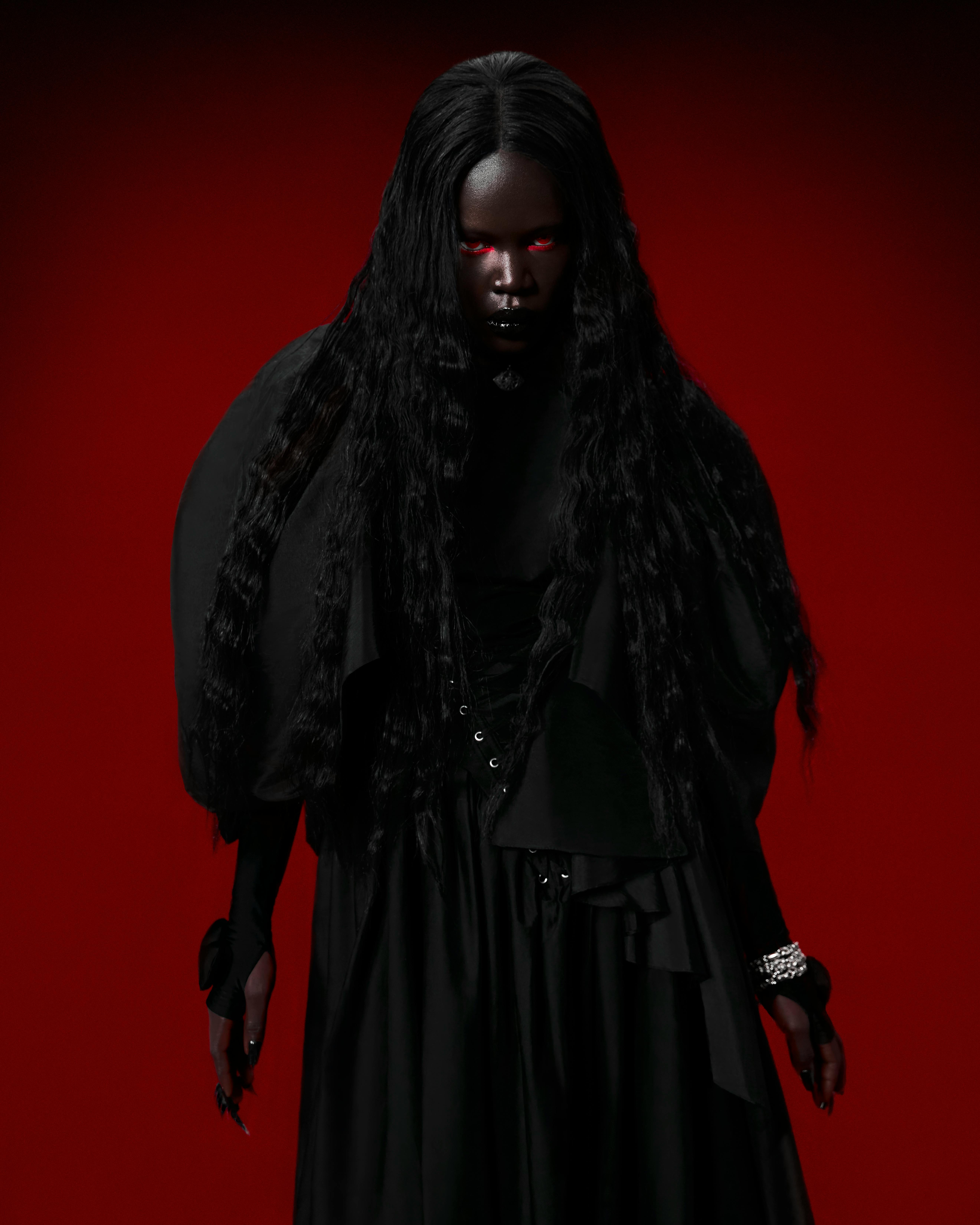
A dark-skinned woman with red eyes wearing all black on a red background stares menacingly into the camera.

Leave your readers with a proper fright after finishing your unnerving tale.

You’re writing your horror book, and everything is coming together nicely: The characters have depth and intriguing backstories; you’ve staked out a creepy setting; and your stalker, monster, cosmic entity, killer inanimate object, etc., is iconic and menacing. You have the components of a great story, yet can’t help but feel that something is missing. You begin to question if you know how to write a horror novel, until you read your manuscript, and only then does it hit you. You don’t feel… scared.

A spider on its web against a dark background with boca effect
Photo by kaboompics. Pexels.

The Importance of a Scare in Horror Story Writing

A well-constructed scare is as important as characters, setting, and plot in horror story writing. It adds bitter flavor, lingering with your readers long after they’ve flipped through the pages. Every ominous shadow in the corners of any room they walk into, strange bumps and thuds in the night, everyday objects that typically don’t frighten them—all because your book left a lasting impact. Tending to your scares with the love and care they deserve keeps your book faithful to the horror genre, and more importantly, makes your book memorable.

I previously compiled a list of excellent horror novel recommendations with bone-chilling scares that you may find useful!

Tip #1 to Write Horror: Find Your Subgenre

Before you begin sprinkling in jump scares or passages of shock and gore, consider the subgenre of your horror book, as each has its own types of scares. A paranormal story relies more heavily on suspense and unease, whereas a slasher leans into jump scares and bloodshed to frighten the reader. If you are struggling to pinpoint your subgenre, consider the following types of horror:

  • Paranormal: events, activities, and entities not scientifically explainable, e.g., ghosts or telekinesis 
  • Psychological: relating to the protagonist’s mind
  • Slasher: a killer or entity preying on a group of people
  • Gore and body horror: concerned with extreme violence and visceral experience
  • Monster: a creature or one’s transformation into one, e.g., werewolves, vampires, zombies

This article covers a more extensive list breaking down these subgenres further, but these are the broad ones worth considering for the sake of this process.

Tip #2 to Write Horror: Harness Fears Effectively

Now that you’ve identified your subgenre, we can look at the different types of fear. Each stroke of horror utilizes different fears, including fear of Death, fear of the loss of sanity, fear of loss of loved people or culture, or fear of pain. 

Consider two classics: Psycho, written by Robert Bloch, utilizes suspense and sudden violence to startle readers in small bursts, whereas The Shining, written by Stephen King, uses the same suspense to establish dread and anxiety that prolongs until erupting into chaos in its final pages. 

These two books reveal different approaches for how to write a horror novel by relying on different types of fear to frighten their readers. It’s crucial to have a solid understanding of your subgenre to know what fears work best. For example, a gore book sustaining the same suspense as The Shining won’t be as effective as one that prioritizes shock and disgust. (For more on how to use a fear of Death in horror story writing, check out this blog.) 

A young Black woman holds open a book and appears engaged with the text.
Photo by Ron Lach. Pexels.

It’s also worth cozying up with similar books and noting their structure. A suspenseful story may involve leaving a trail of unease throughout, and thus requires a different editing approach than a book with quickly established jump scares. That’s not to undermine the importance of maintaining an eerie atmosphere regardless of subgenre (which can be expertly curated utilizing mood boards), but rather to emphasize how scares are catered to differently in horror stories. A revision of your book centered on incorporating these fears can prove useful to heighten the effectiveness of your book. 

Tip #3 to Write Horror: Consider POV

Lastly, and this may sound surprising, but the point-of-view you choose to write your book in greatly matters in how you approach writing scenes that genuinely feel scary. 

First-Person POV

A first-person POV puts readers in the shoes of the narrator, and thus, they can only visualize the narrator’s senses. Curating surprises may be more effective if it focuses on the character’s sudden reaction and feelings toward a scare, told from their perspective. A psychological horror book can utilize confusion to scare readers. You can lean into what the narrator sees and feels that may be abstract or out-of-the-ordinary to play with the reader’s mind, especially if the narrator themselves doesn’t recognize it as peculiar. 

Third-Person POV

Despite the story not unfolding through the narrator’s eyes, a third-person POV can be effective in staging sudden scares or odd occurrences, while also describing the world outside of a character’s immediate view. Great for suspense, a third-person POV allows you to focus on an object or threat that is approaching a character without their knowledge. A monster lurking in the shadows or a ghost appearing on a monitor when someone looks away: A third-person POV is excellent at staging the world outside a character’s direct experiences. 

Even… Second-Person POV?

An excellent example of POV manipulation in horror story writing is in The Only Good Indians, written by Stephen Graham Jones. (Minor spoilers ahead!) The book is mainly written in the third-person, following a group of hunters tracking a monster. In one instance, a character is scanning his surroundings with a gun when he lands on someone, you, the reader, now addressed in the second-person as the monster they’ve been hunting. It’s a masterful example of producing a scare by exploiting POV before the reader can fully comprehend what’s happening. 

If you’re looking for more effective frights, I previously compiled a list of some excellent horror novels with bone-chilling scares!

Map Out and Curate Your Scares

Once you understand your subgenre, its associated fears, and identify your POV, you can begin to establish your scares. There is an extensive list of tips from published writers on what they utilize to startle their audience, and reading other horror books and identifying what about them scares you will inspire you to implement the same techniques when you write horror

Scare Trope Example No. 1: Horrifying "Safe" Spaces

Consider including scares in otherwise-safe spaces. Vividly describing a derelict house or abandoned hospital can be equally valuable in building suspense and unease. Think of Jaws and how the novel (by Peter Benchley) and film (by Steven Spielberg) made an entire generation afraid to swim at the beach, or how the film The Ring (based on Japanese horror novel, Ring, by Koji Suzuki)  recontextualized water wells and TVs as things/spaces to be afraid of. 

Scare Trope Example No. 2: The Unlikely Threat

Another example of a common scare type is an unlikely threat. It could be argued that The Omen (screenplay by David Seltzer) or Children of the Corn (again by Stephen King) largely contributed to a trope in horror involving unease toward children. We assume them unlikely to be a threat, only to be confronted with how horrifying they truly are. Or, how a film like Child’s Play or a novel like How to Sell a Haunted House (by Grady Hendrix) instil in viewers a lurking fear that prompts them to keep their eyes on inanimate dolls…just in case they spring to life. 

Toying with the unordinary and even looking inward at what scares you personally are excellent ways to construct a memorable scare that surprises the reader. You can defy expectations or lean into what already unsettles you and people like you. 

Final Thought About How to Write a Horror Novel

A dark-skinned woman with red eyes wearing all black on a red background stares menacingly into the camera.

A horror book can have intricately written characters or a unique plot, but if it’s not scary (or even suspenseful), readers will feel disappointed. Hopefully, you now feel more confident on how to write a scary scene in your horror novel or short story; hopefully you feel prepared to unnerve and surprise your readers. My final piece of advice for how to write a horror novel is to remember that it is okay to revise and edit until you feel confident your scares are effective. Horror readers love nothing more than the excitement of fear and unease creeping into their daily lives after reading an effective, frightening spine-tingler. Family, friends, colleagues, and professional beta readers can provide valuable feedback that helps you identify what didn’t work and what needs a bit more to really get readers’ hearts racing and keep them up at night.

Ready to speak with an editor about your horror novel?

Posted on 1 Comment

Editor’s Pick: Horror Novel Recommendations for October (and Beyond)

Cover of the book "One of Us Knows" by Alyssa Cole

The countdown to Halloween has begun! And if the crisp air and pumpkins have you craving a terrifying tale, I have a few horror novel recommendations for you. 

Now, horror isn’t my specialty genre, but every year in October, I binge listen to audiobooks that focus on this oh-so-appropriate genre. Some are fun-time spooky and some are downright nightmare inducing. This month is off to a great start for me – connect with me on Goodreads for real-time updates of my reading list. But this year is the first time I’ve put together a short list to recommend to readers who might just be looking for a good horror audiobook fix. 

I also enjoy a good horror tale in the summer, for whatever reason. The sun is out and shining and I’m lying by the pool. Time for murder and carnage, ghosts and goblins, I guess. 🤷‍♀️ 

Now, generally after I read or listen to something, I post a private and very casual review to my friends on social media, which sometimes makes its way to Goodreads, although not usually. The horror novel recommendations you’ll find below here are reposts of what I tell my friends and family about these books. 

Since October has already begun, and there’s way too many in my reading history for me to keep the list short if I include everything I recommend, I’ve narrowed it down to just three horror sub-categories: fantasy horror, psychological thriller, and horror featuring women of color as protagonists (two appear in this category below: one YA appropriate and one for adults). 

It may go without saying, but I’ll say it anyway: Reader discretion advised.

The Salt Grows Heavy

Book cover: Salt Grows Heavy by Cassandra Khaw; editors picks top books read in 2023

The Salt Grows Heavy

⭐⭐⭐⭐⭐

By: Cassandra Khaw

Fantasy-Horror Recommendation

Tagged: adventure, fantasy, women’s lit, romance, LGBTQ+, mom lit, short story

I covered this incredible short novel in my blog, Editor’s Pick: Top Books Read in 2023, so you’re welcome to check that out if you want the full (and extended!) review. 

To what I’ve said there, I’ll add this: this is one of the few horror novel recommendations that maintains its place on my list, even as I read more in this genre, and I’m growing to love this author more with each exposure to her work. 

I listened to another short story from this author in October 2022, returned to her to listen to this in October 2023, and have now returned to her again for my horror reading list of October 2024. She continues to impress me each and every time. 

The Last House on Needless Street

Book cover for The Last House on Needless Street by Catriona Ward

The Last House on Needless Street

⭐⭐⭐⭐⭐

By Catriona Ward

Psychological Thriller-Horror Recommendation

Tagged: 21st century lit, LGBTQ, psychology, horror

This incredible book was an Honorable Mention in my blog, Top 5 Books of 2022, so you might want to take a look there for the full review. 

What I can say is that this has stuck with me over the past two years. As someone with a background in psychology, I have to sometimes be careful about what types of psychological thrillers I get myself in — as they tend to hit deeper nerves than other types of thrillers — but as I continue to read more novels with depictions of mental illness, I continue to think about how well done this one is. Since the time of reading this, I have also listened to books by Mary Higgins-Clark and  Cormac McCarthy, who are both superb writers in depicting mental illness, and I would maintain that this book holds up against those larger, perhaps more well-known writers. 

I predicted when I published my Top Books of 2022 blog that this book would “stick with me for a long time,” and here we are, two years after I read it, and it’s showing up on this short list of horror novel recommendations. I love it when a prediction comes true. 😁

Horror Novel Recommendations Featuring Women of Color Protagonists

For the final category of my horror novel recommendations, I’d like to feature two books that star not only female protagonists but women of color specifically. There has long been discussion in the publishing community about how women of color are not featured enough in the  horror genre, and I agree! #representationmatters

The first book is one I read just this past summer of 2024, so it’s fresh in my mind and still haunts me randomly as I go about my life. The second I read in summer of 2023 and is for a YA audience. I particularly enjoyed the narrative’s delivery of the character’s paranoia in the audiobook, and I hope you will too. 

Both these titles include content warnings for hate crime violence and abuse based on race, as well as depictions of pretty severe mental health crises. The first also receives content warnings for harm to a child. 

One of Us Knows

Cover of the book "One of Us Knows" by Alyssa Cole

One of Us Knows: A Thriller

By Alyssa Cole

⭐⭐⭐⭐

Tagged: horror, adventure, psychology, women’s lit, romance, LGBTQ+, 21st century lit

4.5 stars. Oooo! Spooky! A psychological thriller for your summer reading list. Very well done. 👏👏👏 

Disassociative Identity Disorder (previously known as “multiple personality disorder”) is not particularly well understood or depicted in general pop culture media (books, TV, etc.), and I’m certainly no expert, but I’d say this is extremely well done. Our main narrator is one of the two hosts of this person’s system, a queer Black woman in her early thirties, and she is co-narrated by several of her/their other identities. 👉👈 

While people with DID often experience gaps in time due to various personalities controlling the body’s actions and memories, this novel shows how terrifying that really can become when your whole personhood ends up the center of a mystery that urgently needs solving before more people die or disappear under strange circumstances… 😱 

So while one of them must know what’s going on, all of them will have to work together to save themselves using only the pieces of information available to each. 

Terrifying. Funny. Deeply disturbing depiction of true-to-life trauma caused by people of MAGA ilk. It’ll have you cheering and laughing and gasping in the same scene.👌  

Reminded me of The Shining and The Menu and Last House on Needless Street.

Obviously content warnings. No SA but violence, hate crimes, abuse/neglect of children, mental illness, and more. 💔

White Smoke

Cover of the book "White Smoke" by Tiffany D. Jackson

White Smoke

By Tiffany D. Jackson 

⭐⭐⭐ 

Tagged: psychology, women’s lit, YA, 21st century lit

3.5 stars. A mid-summer ghost story that actually felt like fun summer reading. 

A lot of YA tropes mixed with standard ghost story stock that felt like a fresh twist on some classics I probably read in middle or early high school and just can’t remember now, like “Fear Street.”👻 

This was fresh and modern, with an angsty MC who learns a few valuable lessons along the way. 👩‍🎤 Her dad is in an interracial relationship, and she’s learning to adjust to having a White stepmother and stepsister. She’s also struggling with her own mental health in a few different ways. 

At times it was a bit predictable or obvious, but maybe that’s because I’m an adult who is familiar with the formula. And at times I was honestly questioning what would happen next. Generally, I enjoyed it. ❤️

Do You Have Horror Novel Recommendation for Me?

So that’s it! This is my short list of horror novel recommendations for October 2024. 

If you have suggestions for me, I’d love to hear them! Leave a comment below to let me know what you think I should add to my horror To Be Read list.

Happy reading, and have a great/horrific spooky season!