Posted on Leave a comment

What Does Book Proofreading Include?

Hand holding red pen for book proofreading with typewriter in the background.

What Does Book Proofreading Include?

While many people mistakenly believe all stages of book editing are the same as book “proofreading,” there is most definitely a difference. 

Not sure if your manuscript is ready for a proofread? Asking yourself, “How do I find someone to proofread my book?” Read on for answers!

Traditional Publishing Sets the Standard for Book Proofreading

In traditional publishing, most stages of book editing are done in a word-processing program. As you might suspect, Microsoft Word is the industry standard for document editing. Even if you write your manuscript in Google Docs, Apple Pages, or another word processor with some text enhancement features, expect your editor to convert your manuscript into a Word document to access the fullest range and best editing features available on the market. 

Don’t worry too much about formatting and layout in this software. There are a few things that should be done to make the overall editing process smoother, but don’t get stressed out about making your Word document look like your vision for the final product. For all its wonderful aspects, MS Word is not the best program for finalizing your book manuscript. 

Once all the stages of book editing are complete – which, in traditional publishing, is typically four rounds of edits (developmental, content, line, and copy editing) – a designer at the publisher will use software like Adobe InDesign to convert your manuscript into a “galley proof.” 

This is when your document begins to “look like” a book! The designer prepares your manuscript by adding things like the correct spacing between lines, drop caps at the beginnings of chapters, fancy or final fonts, images with captions, page numbers, headers and footers with your name, the chapter title or book title, and other design elements. At this point, you’ll no longer be working with an MS Word document; your galley proof will have been converted into a PDF file. 

Now, because all these formatting and design elements have been added to the galley proof, it is more difficult to edit and make large-scale changes to it. PDFs are more complex files that hold more information, and making changes to them can require more steps. Once your galley proof has been designed, you are truly ready for book proofreading.

So What Is Involved in Book “Proofreading”?

Different steps in the stages of book editing focus on different concerns. True book proofreading involves a very light touch, where the proofreader focuses on correcting only “true errors.” Your proofreader will review your galley proof PDF and mark up or make specific changes to typos, spacing errors, and style elements. For example, your proofreader might correct capitalization or apply or remove italics where appropriate. Hopefully, your editor has caught most of these, but sometimes during the process of converting your file from a Word document to a PDF, elements get missed or mistakes happen.

Keep in mind, your proofreader is not reading for ideas or content. They are not fact-checking or confirming spellings of names of public figures or other Google-able information. They are not going to give you feedback on character development or plot holes. They, honestly, are not really paying attention to the same things your editor should have paid attention to. They are focused on finding those true errors that your editor may have missed or that could have even been introduced at some point during the editing or file conversion process. They are focused on checking the consistency of design elements and making sure everything “looks right” in addition to the text being as error-free as possible.

Why Is Book Proofreading Important?

Your proofreader is the last set of eyes to go through your manuscript before it goes to the printer. Hopefully, your proofreader finds an error only about once every 1,000 words (or even less often!). By the time the PDF gets to them, it should be mostly clean and polished. Mostly finalized. So close to done that it only needs one more read-through, and that read should catch so few errors that it takes only a few minutes to finalize once they return it to the graphic designer. Then, your approved galley proof goes off to the printer!  

It’s important to understand this process because when you ask someone “Can you proofread my book?,” you’re asking them to pay attention to the smallest details, not the big-picture issues, and you’re trusting them to have a razor-sharp eye to prevent even the smallest error from making its way into the published version. 

Of course, people make mistakes! No one is perfect. And having multiple professionals involved in the various stages of book editing helps to catch as many errors and address as many concerns as possible. Even traditionally published books that have gone through so many rounds of editing and proofreading might still contain errors when they are released to the market. So give a little grace and have a little patience. Proofreaders are doing their best to help make your book as perfect as it can be, but they might miss one or two things if your book is particularly long or dense, or if on a tight deadline.

What Should I Be Aware of When Hiring a Pro to Proofread My Book?

While this blog has discussed the standards found in traditional publishing houses, self-published authors can follow the same process. Some editing might be combined into a single step in the stages of book editing—such as having the same editor perform both content and line edits—but each book should have separate steps for editing and proofreading.

The lesson here is that, as an educated author, you should be aware of the differences between the stages of book editing, including book proofreading. Don’t confuse the two! Of course, there are similarities, and experienced editors can be excellent proofreaders (and vice versa), but don’t tell your editor that your manuscript “only needs a proofread,” unless you’re convinced that it’s so clean and error-free that it’s ready to be put into PDF format. If there are no more changes to make – other than adjusting for true errors – you’re likely ready for a true proofread. Ask a professional for a sample edit or proofread of up to five pages to allow them to determine which type of service your manuscript needs. Once they have evaluated that you’re really ready for a proofread, get excited, because it means that your book’s launch date is just around the corner!
Ready to discuss your book proofreading?

See Related Blog Articles...

Posted on Leave a comment

Excellent Experience at the Read It Write It! Book Festival

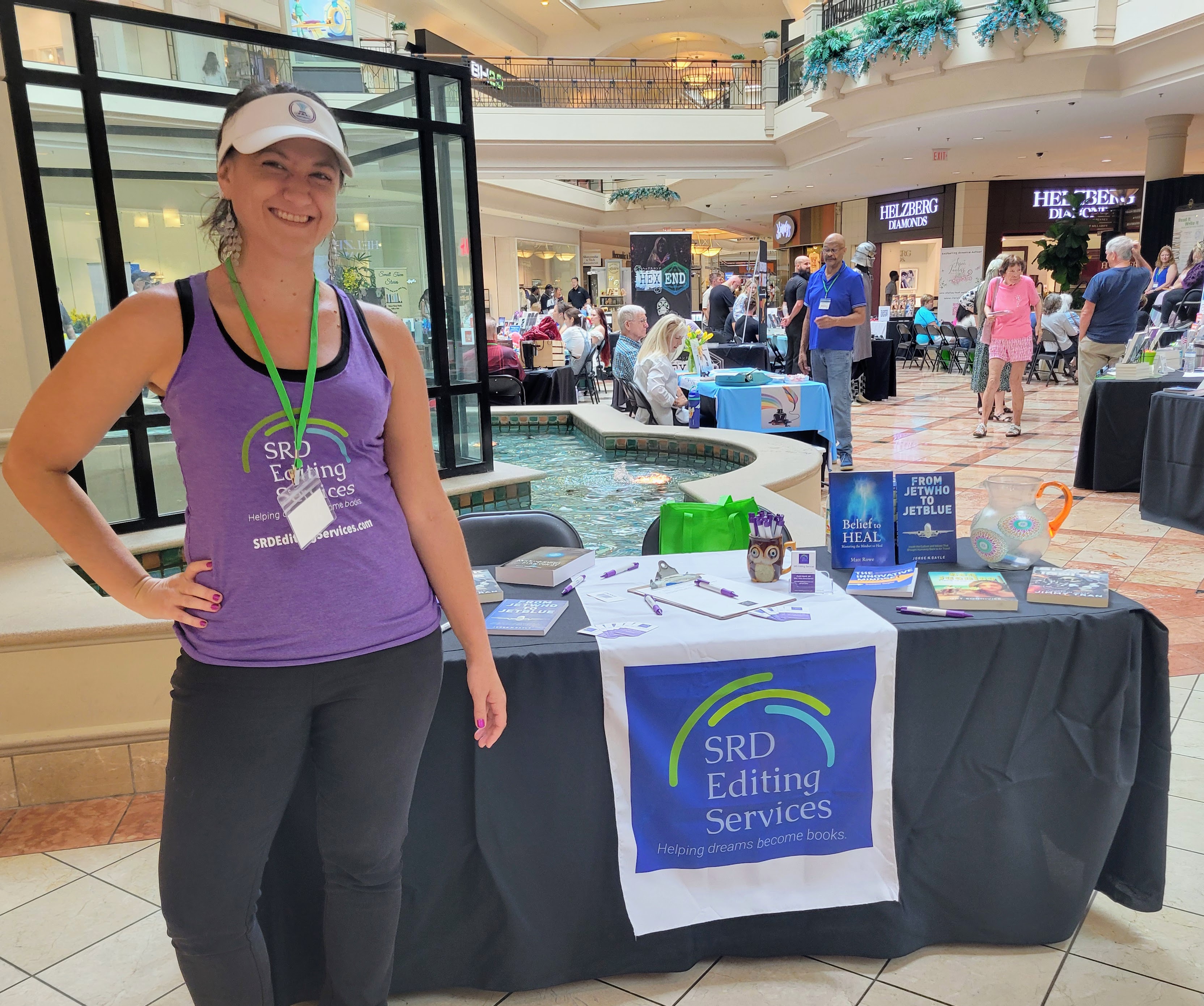
Cortni Merritt MA stands next to her table at the Read It Write It book festival in Wellington Florida on June 14, 2024

Read It Write It Book and Writing Festival

Editor Cortni had a wonderful time at the Read It Write It Book and Writing Festival 2024. The event took place at the Mall at Wellington Green on a bright and sunny Saturday, June 15, a perfect backdrop for the sunny group of writers who met to swap ideas and share their stories. While most writers were local to central or south Florida, at least two had traveled from Georgia and South Carolina to connect with other authors.
The most represented genre was romance, with everything from sweet to spicy making an appearance. Additionally, fiction genres of various authors included fantasy, small-town mystery, and science fiction.
Our editor also spoke with authors of nonfiction, including memoir and social/political critique and analysis. Additionally, several authors at the event were showcasing their children’s books as well.
Speaking of a showcase, SRD Editing Services was privileged that several of our own writers were kind enough to send copies of their printed books to display and distribute. Cortni gave away several copies of various books from the display at no cost to interested people. We love sharing and promoting our authors’ work and hope everyone who walked away with a copy enjoys their gift!
SRD Editing Services display table at the Read It Write It book and writing festival 2024
SRD Editing Services display table at the Read It Write It book and writing festival 2024.
Throughout the event, there were several highly interesting panel discussions. Panelists included award-winning authors and publishers of a variety of materials Unfortunately, due to our table placement and the acoustics of the venue, they were sometimes difficult to hear unless stationed near the seats at the front of the stage.
When visiting various writers’ tables, we saw inventive, interesting merchandise from numerous authors, including 3D-printed figurines of characters, colorful and creative stickers, bookmarks, calendars, and notebooks. Several writers described using QR codes to lead readers to Spotify playlists that accompanied their stories.
Perhaps most interestingly, one author of a children’s book explained how he integrated a QR code for readers to scan in order to access augmented reality features designed to enhance the kids’ reading experience. How cool! Can’t wait to check it out.
There was so much talent that the room was bursting with it. In addition to all the writers, publishers, and illustrators, Cortni even chatted with a few future editors who stopped by the table to ask for advice.
At the end of the day, no visitor left empty-handed. Whether you picked up some merch or some swag, you at least walked away with the knowledge that the book reading and writing communities are strong in South Florida.
SRD Editing Services is looking forward to maintaining these new connections and growing these new relationships with all the Read It Write It authors over the next year. In fact, the date has already been announced for 2025, and we’ve submitted our interest form. See you in June next year!
Posted on Leave a comment

Planners Vs. Pantsers: Tips for New Writers on Navigating Your Writing Journey

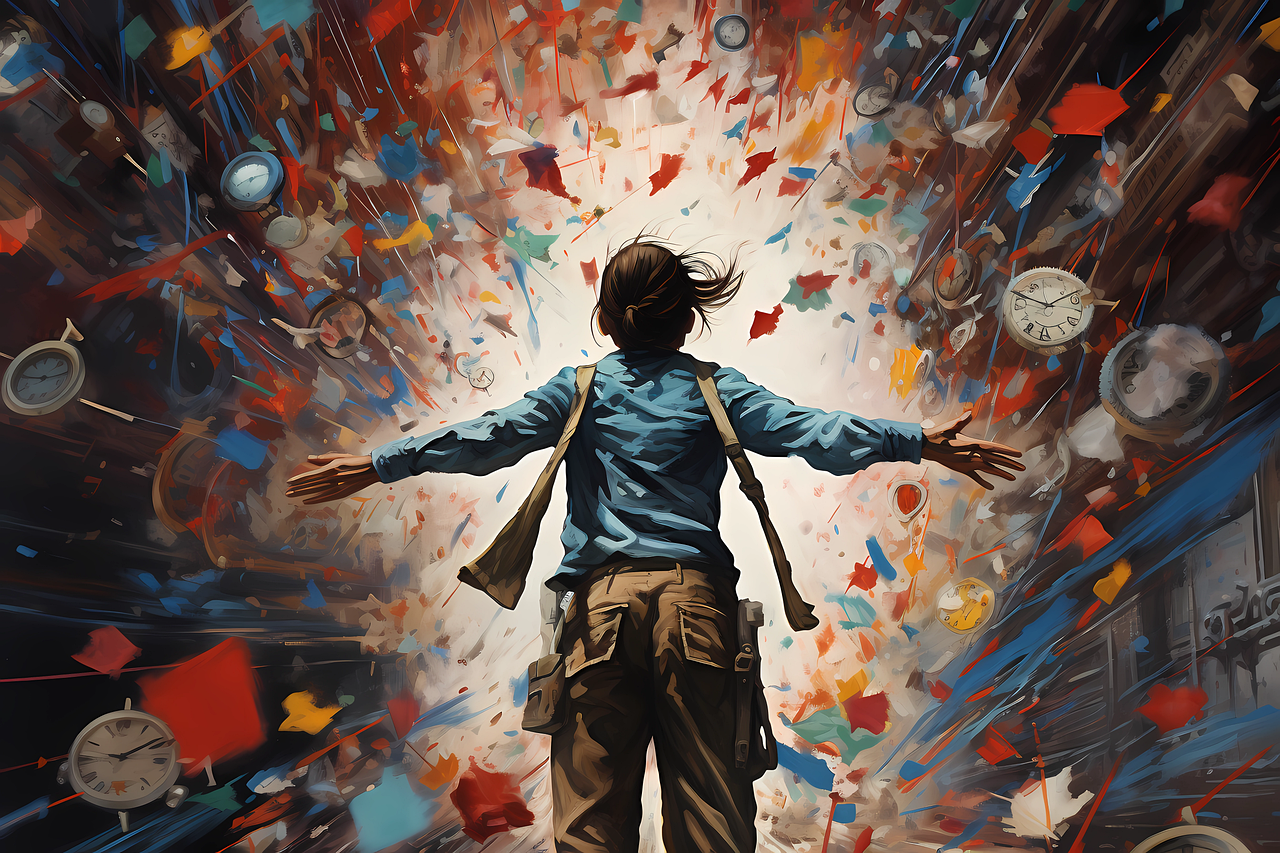
An AI image of a woman's back. She is wearing blue shirt and khaki pants and facing an explosion of colors, clocks, and perhaps scraps of paper. Symbolizes how pantsers approach the creative writing process by prioritizing spontaneity and creativity.

Writing is a unique journey, and every writer has their own style. Some meticulously plan every detail, while others embrace spontaneity and write “by the seat of their pants.” As an editor who has worked with both types, I’ve come to appreciate the strengths and challenges each style includes. In this blog, we’ll explore the worlds of planners and pantsers, providing valuable tips for new writers on self-publishing and the various stages of editing a book.

Planning Your Path: Crafting a Literary Blueprint

The Planner's Playground

A notebook and pen with crumpled pieces of paper on a wood desk; symbolize the planning type of writer in discussion of tips for new writersPlanners, or “architects,” are writers who thrive on structure. Here are some tips for new writers who want to take this meticulous approach:

1. Develop a Detailed Outline

For planners, the key lies in crafting a comprehensive outline as a crucial stage. Break down your story into chapters, noting character developments, key events, and thematic elements. This roadmap will guide you through the writing process, minimizing the risk of getting lost in the narrative wilderness.

2. Explore Character Motivations

While planning is your strength, be wary of falling into the trap of a too-rigid structure. Take time to delve into your characters’ motivations. Understanding their desires, fears, and conflicts adds depth, preventing characters from feeling flat or lifeless.

3. Avoid Rushing Things

Planners may be tempted to rush through scenes because we know the outcome. Be mindful of pacing during these drafting stages. Don’t sacrifice tension. Ensure each scene serves a purpose and contributes to the narrative arc. During later stages of editing a book, you can trim or add as necessary.

Learning from Pantsers: Valuable Tips for Planners

While planners excel at creating structure, there’s much to learn from the spontaneity of pantsers. As a dedicated planner, I often work with pantsers who remind me of the magic of spontaneous creativity. During brainstorming or creativity sessions, often unplanned ideas emerge and transform the entire plot. These revelations can result in some of the best elements of a finished story. You’ve got to allow space for the unexpected.

Embracing Spontaneity: Tips for New Writers Who Write by the Seat of Their Pants

The Pantser's Playground

An AI image of a woman's back. She is wearing blue shirt and khaki pants and facing an explosion of colors, clocks, and perhaps scraps of paper. Symbolizes how pantsers approach the creative writing process by prioritizing spontaneity and creativity. Pantsers, or “gardeners,” revel in the thrill of uncertainty. Here are some tips for new writers who find that this spontaneous approach works best for them:

1. Start with a Seed

For pantsers, begin with a single starting point – a character, an image, or a theme.This starting point can give you something to help your imagination run wild. Enjoy freedom from the constraints of a detailed plan, but give yourself a starting point as a seed from which your story can grow organically.

2. Embrace Plot Holes

Pantsers may find themselves overlooking plot holes, assuming that the narrative threads will magically tie together later. While spontaneity is your strength, be open to revisiting and filling in those gaps during later stages of editing a book. Your story should make sense to readers who don’t have the privilege of seeing everything in your head.

3. Balance Creativity with Structure

While celebrating your spontaneity, be mindful not to veer into overly indulgent or “purple” prose (or be prepared to edit it closely later especially if you’re self-publishing). Every reader craves a sense of overall story structure. Your narrative should be coherent and provide readers with a clear, engaging journey through your creative landscape.

Learning from Planners: Valuable Tips for Pantsers

Pantsers may be tempted to rush to put down all their thoughts, no matter where it leads the reader because they are enjoying the journey their characters take them on. Be mindful of losing your readers and having them drop out of the story because they couldn’t follow along. Don’t sacrifice clarity or cohesion. Make sure your wild ride still follows the standard “hero’s journey” or demonstrates a clear character arc by at least leading the reader to an end that makes sense based on the beginning. 

Still got questions? Check out this video from Jenna Moreci with tips for new writers, “10 Best Tips for Plotting Your Novel.” 

Image shows black text on white background of a 3x3 table explaining different types of planner and pantser writers. Can be helpful in self-publishing and different stages of editing a book.

The Editor's Role in Different Stages of Editing a Book

Whether you meticulously plan or live the pantser life, both approaches benefit from a skilled editor’s touch and multiple stages of editing a book. One of my top tips for new writers is: Do NOT try to do all the editing at once. You will miss so many things. 

As an editor, especially for self-publishing authors, my role is to enhance the manuscript while simultaneously respecting the writer’s unique style. Here’s how I navigate the challenges for both planners and pantsers during editing:

Guiding Planners through Editing a Book

  • Addressing Rigid Structure: I guide planners to help balance their detailed plans with spontaneity. It’s important to encourage flexibility within their detailed (and sometimes very thorough) plan, which allows for authentic character development.
  • Tackling Rushed Pacing: For planners prone to rushing through scenes during the drafting of their book, I focus on pinpointing areas where slowing down can heighten tension and emotional impact. Could the scene use more description? More emotion? More dialogue. Identifying and addressing these types of gaps ensures a more satisfying reading experience.

Supporting Pantsers when Editing a Book

  • Filling Plot Holes: Pantsers may overlook plot holes or assume readers will connect the dots, but sometimes the manuscript benefits from a bit more obvious storytelling devices. My role is to gently guide the pantsers who resist structre and help them identify and fill in gaps so the reader sees how each scene logically builds from the previous one.
  • Maintaining Coherence: While celebrating spontaneous and quirky action, sometimes this takes the whole plot in a totally unintended direction. Often, writers realize this and try to steer it back to its original direction, but they sometimes need help maintaining coherence. A cohesive structure doesn’t mean sacrificing creativity; it ensures readers can navigate the narrative landscape without feeling lost.

Developmental Editing & Beta Feedback during Self-Publishing for Planners & Pantsers

Regardless of your writing style, the journey is incomplete without multiple rounds of editing, which can include developmental editing, beta reader feedback, and separate steps for line editing and proofreading, especially when self-publishing. Among the best editing tips for new writers – planners and pantsers alike – is that they can benefit from these crucial steps:

Embracing Developmental Editing when Self-Publishing

  • Strengthening Weaknesses: Developmental editing focuses on enhancing a manuscript’s strengths and addressing weaknesses. Whether it’s refining a detailed plan or filling in gaps left by spontaneity, this stage of editing a book is about refining your unique voice and making sure your message or story is clearly communicated.
  • Gaining External Perspective: A skilled editor provides an external point of view, identifying elements that might be unclear or inconsistent to a reader who can’t see inside the writer’s mind. A fresh set of eyes ensures your unique story resonates with a broader audience.

Tips for New Writers to Harness Beta Reader Feedback when Self-Publishing

  • Diverse Perspectives: Beta readers should be among your target audience. They can help highlight what works, what resonates, and where they felt disconnected from the text or confused by the story. Their feedback is invaluable in shaping your story so that appeals to your target readership.
  • Testing Emotional Impact: Beta readers help gauge the emotional impact of your story, an essential consideration for self-publishing and something you can absolutely tweak during the stages of editing a book. Do they feel connected to the characters? Are your plot twists effective?  Your beta readers’ responses guide you in fine-tuning your manuscript for maximum reader engagement.

Planning or Pantsing Your Writing Can Make for an Awesome Journey

Whether you meticulously plan every detail or let the words flow organically, your writing journey is a personal and evolving experience. Embrace your unique style, recognizing the strengths it brings to your storytelling.

As you embark on this creative adventure, remember that both planners and pantsers can learn from each other and there’s room for both in the traditional and self-publishing worlds. The careful architect can infuse spontaneity into their writing, while the adventurous gardener can benefit from the structure that ensures a satisfying reader experience. And both can address issues of structure or plot development in the stages of editing a book. 

Ultimately, every tips for new writers list should emphasize how the magic happens in the balance – a harmonious dance between planning and spontaneity. As you refine your craft, celebrate your individuality, and let the words guide you on your journey to becoming a seasoned and versatile writer, you’ll find the special mix that is just right for you.

Explore the Stages of Editing a Book with SRD Editing Services

Posted on Leave a comment

Books and Publishing Discussion: Should Books Include a Credits Page?

Blue sign against brown wall reads "Cinema" used to highlight the similarity between credits at the movies and books and publishing credits pages.

I read an article recently that got me thinking about changes to the standards in books and publishing. We’re all familiar with the “credits” that run after audio-video productions (TV shows and movies), but what if books had a “credits page” in a similar fashion? Avid Press, says Publishers Lunch, is making a credits page standard in their book template. 

The credits page at Avid Press will name workers across a number of departments including editorial, marketing, production, artwork, and more, as well as thank the “hundreds of professionals in the Simon & Schuster audio, ebook, finance, human resources, legal, operations, sales, supply chain, subsidiary rights, and warehouse departments whose invaluable support and expertise benefit every one of our titles.”

This step by Avid Press is commendable. As readers, we often don’t recognize the contributions of all the professionals in the traditional publishing process. This move aligns with the practice of acknowledging the collaborative effort behind a book’s publication, and allows readers to familiarize themselves with the specific names of editors, graphic artists, and other industry professionals whose work they admire, even if they weren’t initially aware.

While authors may sometimes include acknowledgements in their book content, they typically recognize the editors and beta readers whose names they knew and can remember, alongside mentors, family members, and friends. Acknowledgments are still important in that they allow the author to thank these individuals for their support, feedback, and assistance.

On the copyright page, sometimes, the publisher will include information about the cover art, lead editor, photographer, illustrator, or another high-ranking contributors to the book and its publishing process, but this is not standard across the industry and is typically mostly concerned with, of course, copyright protection rather than credit for excellent work done. 

However, a full credits page (or two) would help support and empower all the industry professionals who work “behind the scenes.” Including this in books and publishing the names of technical and support staff provides more transparency and a more thorough accounting of every step of the process for the publisher as well as the professionals.

Positives to this Change in Books and Publishing Standard

Recognition.

One of the primary reasons to include credits in a book is to express gratitude and recognition to the individuals who have contributed to the creation and success of the book. Industry experts currently don’t have a lot of options to showcase or portfolio their work, or it can be cumbersome, or they may be under contract not to reveal their role in the production. 

Since we’re looking at credit pages as similar to a credit reel at the end of a TV or film production, let’s consider the parallel that these credit pages may begin a database for publishing professionals similar to the IMDB listings for all film industry cast and crew members. Currently, if an editor is listed on the cover of a book, Goodreads will allow the professional to tag themselves as “Editor” on that title, but there is no standardized system for books and publishing industry pros who brought them to life.

Professional collaboration.

Even the team members who work together on various projects may not be aware of their overlapping expertise or experience. Someone’s talent may only get around a limited circle due to old-fashioned word of mouth. In today’s world of freelance work, short-term contracts, and various mergers and acquisitions in the publishing industry, professionals may have difficulty networking or navigating with other industry professionals over time. Including a credits page in books, and publishing the details of teams of professionals, would assist editors, graphic designers, audiobook professionals, and more to admire each other’s work, promote projects done by teams they know and trust, and collaborate with other skilled and credited individuals to produce the best books possible.

Reader connection.

In much the same way that team members aren’t able to track the success and movements of their collaborators, readers have nearly zero knowledge of who worked on their favorite books. But, much like movie fans can sometimes target their fandom to a particular professional like a stunt coordinator, costume designer, or sound effects team, book fans may want the same opportunity to follow, like, and subscribe to their favorite book editors, cover artwork designers, and marketing teams who really knock the promotion out of the park (ehrm, off the shelf?) …

Especially in a world of increasing self-publishing, readers may appreciate being able to visit an online profile of one of their favorite book publishing professions, which is linked to other projects in the professional’s portfolio, and thereby discover new and exciting books (and publishing connections) to explore.

Potential Drawbacks to this Change in Books and Publishing Standard

Clutter.

Adding pages to the book’s front matter creates “clutter” that readers must skip past to get to the main section of the book. Adding pages to the book’s back matter means they may never be seen by most readers (although, arguably, the way that credits are often not seen by moviewatchers either). Adding any bulk/pages to the book can also increase the weight or cost.

Traditional and individual books and publishing professionals might consider adding only a single page to the book itself, with a short listing of lead positions on the book’s publishing journey and a QR code or URL link where the reader can find a complete credits listing. If the publisher decides to include the full listing in the book, it should be well-formatted and constructed to maintain the book’s aesthetic. 

Inclusion & Hierarchy

During the publishing process, errors inevitably occur. A traditional publisher may incorrectly omit or miscredit individuals on their team. There is also the order of crediting different positions to consider, and whatever hierarchy is determined, it’s likely that someone will be unhappy with the result. These hurt feelings can lead to potential legal troubles if someone feels their work was not appropriately or adequately recognized. 

In the case of a self-published author of books and publishing a credits page, the self-publishing author may be dissatisfied with the work of one of the professionals and unhappy about promoting them within their finished book. And because the self-publishing author is doing much of the work themselves, including a credits page may be an extra step that seems unnecessary.

Privacy.

In both traditional and self-publishing, the idea of a credits page brings up questions about privacy, disclosures, confidentiality, and consent. In the case of traditional publishing, not all contributors may want public acknowledgment (for whatever reason), and this change is standard could be detrimental to their privacy. Especially if they’ve performed a role such as a sensitivity reader, they may not want to make themselves a target of readers who don’t like how a certain book turned out. In the case of a self-publishing author, especially one who is using a pen name, the credits page may be advisable only on a case-by-case basis.

A Template for Self-Published Books and Publishing Professionals

Personally, I hope other traditional publishers and more self-publishing authors will adopt this practice. Including the credits of publishing contributors for the book in the book offers a promising vision for the future of books and publishing. It’s a move that can elevate the industry and highlight the often-overlooked contributions of many professionals in the book creation, production, sales, and marketing processes.


Because this is a new and ongoing discussion, I’d love to hear what you think! If there was a template for a credit page that you could use for your self-published books and publishing projects, would you use it? 


Leave a comment below with your thoughts!!

For More Thoughtful Discussion on Books and Publishing Topics, Subscribe to the Blog