Posted on Leave a comment

How to Write an Authentic Author Bio that Speaks to Readers

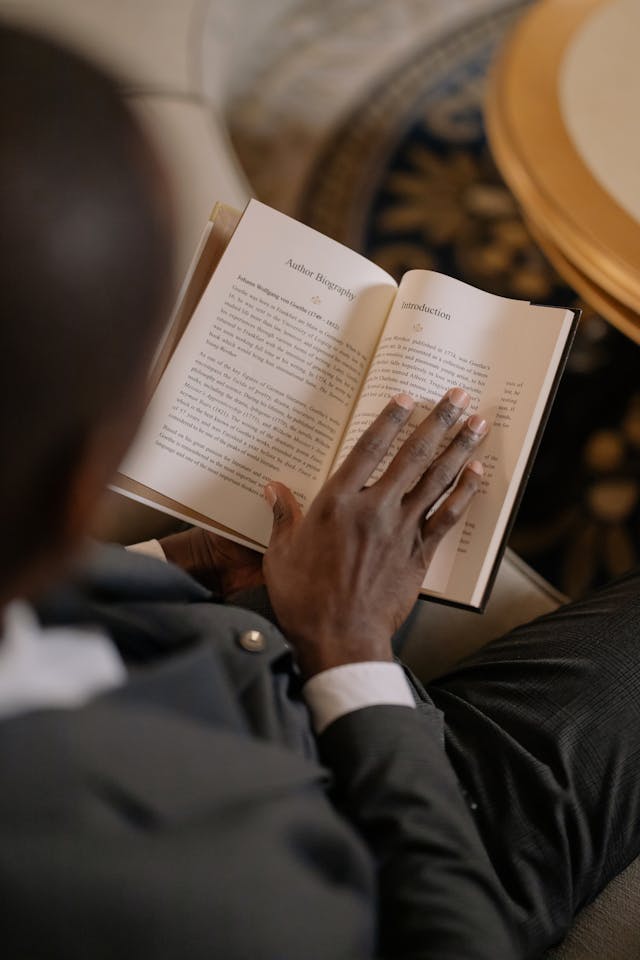
Close up on man's hands holding book opened to Author Biography

Unlocking an amazing author bio may be easier than you think.

Whether you’ve finished your book, are starting the writing process, or are somewhere in the middle, chances are you’ve thought about your author bio. You know, the “about me” blurb every author has on the back cover and inside the back matter or on the jacket of their book? Maybe you’ve tried drafting some ideas, and it doesn’t sound right, or it doesn’t quite line up with professional bios you admire. Writing the perfect author bio can be tricky, especially when self-publishing a book and you don’t have a marketing copywriter to help. 

Also writing the back cover description for your book? Check out my previous blog to help you write your back cover copy.

Wooden blocks spell out Author; author bio description

The Importance of a Stellar Author Bio

An author bio allows your reader to connect with you before opening your book. The back cover, as we know, functions as sales copy, and in your blurb, you’re selling yourself. The back cover bio blurb gives readers a hint of who you are, what you’ve accomplished, and why you’re telling the story they hold in their hands. Whether you’ve written a collection of poetry, a full-length novel, or a memoir, a clear, concise, compelling bio can magically hook readers who are deciding which book to invest themselves in. 

It is, of course, equally important to write a bio that fits your genre. An author blurb for a steamy romance novel will differ from the blurb for an author who writes true-crime retellings. Familiarize yourself with the styles, keywords, and tone of successful authors in the genre in which you plan to publish your book. Looking at the author bio examples from best-selling and crowd-favorite writers in your genre will give you insight into what readers, including your future audience, will expect. 

Two Types of Author Bios

There are two types of author bios you’ll want to include in your book. A brief (25-50 words) blurb for the back cover of your book, and a longer (50-250 words) in-depth author biography for the inside of your book, usually located in the back matter, after the main text of the book itself.

General Rules for Author Bios

Before we dive into the structures of your two bios, here are a few general tips:


  • Write in the third person. It’s standard practice to compose your blurb and bio using this perspective, especially if you’re a new writer, and even if you’re self-publishing a book. (Pretend you’re that marketing copywriter at the publishing house!)
  • Concision is key. Avoid redundancy.
  • Balance the tone between personable and professional. You want readers to relate to you, but sounding too friendly or, conversely, superior can drive people away.
  • Use a tone consistent with your book. This mainly affects the inside bio. Tone is your secret weapon, as it establishes credibility and contributes to writing style.

Writing a Back Cover Bio

Woman holds orange book over her face showing the back cover copy and author bio
Photo by Polina Zimmerman. Pexels.

The back cover author bio is straightforward, typically 1-2 sentences. Write concisely, and sell yourself. Think of it as a way to establish credibility as a writer on your book’s topic or theme. 

Your first sentence should contain the basics: your name, where you’re from or currently reside, and your occupation. If your occupation is irrelevant to your book or writing career, instead, say why you have written your book. Ask yourself, “What drew me to telling this story?” Then, answer that question for your readers. 

As for the second sentence, list any relevant awards or accolades. Don’t have any? No worries! State your goal for writing the book, or what you hope to accomplish with your writing in general. Avoid the trap of imposter syndrome, believing that less recognition means less capability. A strong bio will draw readers in, regardless of the author’s status. 

Please note: You don’t have to include that you are a first-time author. It typically doesn’t matter to readers!

Back Cover Author Bio Examples

Note the use of third-person POV, the concise word choice and descriptions, and the approachable tone used in these author bio examples. The first two focus on experience and professional credentials with writing in different genres:

Marie Collins is a professor at the University of Central Florida with a love for science fiction. Her work has been featured in the Orlando Sentinel, and she holds the 2024 Orlando Authors award for best fiction story. 

Keenan Reed is an acclaimed journalist from  Los Angeles. He formed Reed All About It in 2012 to platform LA writers and bring insightful, honest news to the forefront of journalism. 

This is the perfect formula to follow for first-time authors self-publishing a book, or writers launching into new spaces from other projects: Who are you, what have you done, what are you about?

But what if you want to add a touch of humor to your author bio? Perhaps that is appropriate to your genre, and you’d like to include a bit of personality. 

The bio for children’s writer Dav Pilkey is as follows: 

In the second grade, Dav Pilkey created a comic book about a superhero named Captain Underpants. His teacher ripped it up and told him he couldn’t spend the rest of his life making silly books. Fortunately, Dav was not a very good listener. 

Playful, tells the story of why he wrote this book, gives an idea of his style and voice. 

The bio inside Trevor Noah’s memoir, Born a Crime: Stories from a South African Chilldhood reads: 

Trevor Noah is a comedian from South Africa. 

If you didn’t know who the comedian was before reading the title of his book, the author bio doesn’t give you much more to go on, but it does give you a sense of the style of humor (and humility) you’ll find within. 

Need some help writing or perfecting your back cover copy, including the author blurb? SRD Editing Services offers services for both writing copy for you, or editing copy you’ve written.

Writing the Bio for Inside the Book

Close up on man's hands holding book opened to Author Biography
Photo by cottonbro studio. Pexels.

If you were hoping to give readers a more authentic sense of who you are beyond a two-sentence blurb, your inside biography is your chance to shine. Some authors utilize an entire page, but assuming you are beginning your writing career or self-publishing a book, you may only need a paragraph. 

Your first two sentences will look similar to your back cover bio. Include your name, location, occupation, and qualifications or awards. You have leeway to embellish, but do so in as few words as possible. (Stay on target…)

As for the third sentence, elaborate on what connects you to your book. Why did you write it? What gives you credibility in exploring this topic? Is there an emotional tie you have to your book? This sentence is your chance to tell readers why this book is important to you. 

Finally, close off your bio with a personal detail to humanize yourself. Think of your hobbies, your family, your home; what about you is most interesting that readers can relate to as a human being? Take a look at the author bio examples from writers in your genre; you may find there’s a pattern to the types of details they include and what readers connect with.

Author Bio Examples for Inside the Book

In the following examples, note how the first two sentences could be repurposed for the back cover of the book: third-person POV, concise wording, and approachable tone. The final two sentences give readers deep and unique insight that aligns with the genres for each writer–history and mystery:

Mauricio Betancourt is a historian born and raised in Chicago. His work frequently explores the city and its history, with some of his pieces featured in the city’s American Writers Museum. He traces this deep admiration to childhood trips to museums with his mother. When not writing or strolling downtown late at night, he can be found watching classic movies at home with his wife and their tabby cat, Pepper. 

***

Saki Toshiko is a third-generation Japanese American with a Master’s Degree in Composition & Rhetoric. As a college student, she won several fiction writing competitions in mystery and drama. Growing up in a quaint ghost town, she became fascinated by the supernatural and their wanderings on earth. Saki currently resides in Seattle, where she frequently tours its underground city, preparing for her next novel. 

But what if you don’t have accolades, awards, and credentials to include? That’s OK! Include the details that make you you and what you feel you have to say that readers might connect with. 

The following author bio example showcases how one writer balances between establishing herself as knowledgeable on the topic and providing the reader with a sense of her welcoming style: 

Nooky Bhojwani is a twin mom who writes from the heart about the raw, beautiful, and challenging journey of motherhood. After becoming a mother to twin girls, she embraced the path of spiritual growth, resilience, and unconditional love that comes with raising two little souls at once. Through her writing, Nooky shares honest stories from preconception, pregnancy, and postpartum to the early toddler years, weaving in her own healing practices of yoga, nutrition, and spirituality. Her hope is to encourage and comfort other mothers by showing that they are never alone in their struggles and triumphs. When she’s not writing, Nooky enjoys simple moments of family life, exploring holistic living, and creating supportive spaces for other moms on social media.

Final Polish and Online Uses for Your Author Bios

Of course, proofreading is key. The back cover and interior author bios should both be free of grammatical errors. Consider sharing your bios with friends, family, your editor, and other writers in your genre whose feedback you value. Ask them if the biographies explain you clearly and if there’s anything they suggest adding or removing. This is an excellent practical application to test how effective your bios are with people who know you well. 

One of the key things to remember is that your author bios won’t simply live within your book’s pages. When you are self-publishing a book, you will have opportunities to post your author bio on various websites. Of course, you might have a longer About Me on your own website, but when you create your account on a publishing platform (like Amazon or IngramSpark), you can use one of the author bios you’ve already written. If you market use press releases, podcast interviews, or local speaking engagements or book readings; if you submit poems, short stories, or other items to various publications, they may also ask for your blurb. If you decide to start publishing content on Medium, Substack, or any of the other online platforms, you’ll have a usable, professional, and polished author bio ready to go. 

An open book lies flat on a table next to rocks and a miniature globe; about the author wrap up
Photo by LAYİHA. Pexels.

As you continue your writing career and publish more books, you’ll have chances to update your bios. Revise when you release a new book, and add new honors, awards, or relevant personal details that build your credibility or help to connect with your audience in a new way. Remember, you are selling yourself to readers every time they come across your name. A stellar author bio can lead to lifelong fans along your publishing journey.
Ready to speak to an editor about your book and author bio?

Posted on 2 Comments

How to Write a Back Cover Blurb & Online Book Description

Hand selecting book from a shelf; how to write a back cover blurb

Wondering how to write a back cover blurb for your book? Especially if you’re venturing into self-publishing, this can be a sticky and even controversial topic. You are not alone as a self-published writer wondering what makes the best back cover copy for your book. Self-published authors grapple with this every day, working to create an enticing summary that compels readers to open their book and dive in. Today let’s discuss some of the key elements that make your back cover blurb the best it can be, regardless what genre you’re publishing.

Back Cover is Both Sales Pitch and Art

Essentially, the back cover of your book is a teaser that provides readers with a summary of the main plot points that set the story in motion, while giving your reader a sense of the theme at the heart of the story, and without giving away too much that the reader feels disappointed if there is no more to the book than what is included on the back cover. No big deal, right?

Your back cover is also a sales tool, as it often pitches the story to a potential reader before they have any other exposure to it. It should intrigue potential readers, making them eager to discover what lies within. A well-crafted blurb may also feature a brief endorsement from a fellow author, ideally someone well-known in your genre who can vouch for your writing prowess and the merits of your work. But a lot of readers become disengaged if the back cover is nothing but endorsements and blurbs, so make sure that if you include an endorsement, it’s a real doozy.

How to Write a Back Cover Blurb: The Structure

Typically, there is a common approach in how to write a back cover blurb to address the main questions readers have without violating space constraints. Most professionals divide the back cover of a book into a structure of four paragraphs. The opening paragraph addresses the central questions of your story: What does your main character desire, and what obstacles stand in their way? If you can distill these key elements into just a few sentences, you’re on the right track.

In the second and third paragraphs of your back cover blurb, you should also touch on the main themes of your book and offer hints about your target audience. Tell your readers: Who will love this book? Some authors mention comparable titles, while others incorporate keywords, major themes, and symbols that readers can infer from language choices.

Throughout the back cover blurb, keep readers guessing by offering them something “the same but different” as you nod to the familiar while presenting something fresh and exciting. You want your book to feel both comforting, like a cozy visit to their favorite place, and adventurous, like an exploration of uncharted territory.

If Including an Author Bio

For your author bio, keep it concise. Limit it to two sentences, sharing your background, what you’re known for, and your current achievements. If this is your debut novel, mention that specifically. If readers want to learn more about you, they can easily find additional information via a quick online search or by visiting your website.

What About the Online Book Description?

Now, let’s talk about online book descriptions, which is a bit different from how to write a back cover blurb but a lot of the same principles apply. So the thing about physical book descriptions is that they take up real space on a real object, and they have to fit within standard limitations in order to be palatable to real readers. Unlike physical book covers with space limitations, online bookstores allow more flexibility with description length, but you must make sure to strike a balance.

So in your online book description, you can go a little wild. Within reason.

While you can provide more information online, avoid giving away the entire plot or revealing the ending before readers make their purchase. Don’t give away the whole book for free. You don’t want your online description to become too wordy. Keep it to the point and engaging, so readers will be enticed to hear everything you have to say.

Tips for Clickable Online Book Descriptions

Today’s tips for online book descriptions that maximize click-worthiness:

  1. Summarize what readers will gain from your book: Begin with a compelling “In this book, you’ll learn…” statement.
  2. If your book is part of a series, dedicate a few sentences to providing context and building anticipation for readers by discussing previous and upcoming plot points.
  3. Consider adding content warnings and comparisons like “Perfect for readers of…” to help readers identify if your book aligns with their interests or preferences. Highlight aspects such as female-led groups of characters, LGBTQ themes, or neurodivergent representation to attract your target audience effectively.

How to Write a Back Cover Blurb: Take the Time to Get it Right

By mastering the art of crafting back cover blurbs and online book descriptions, you can engage potential readers and entice them to embark on a literary journey within the pages of your book. Some writers love polishing their back cover copy and online book descriptions, but if you’re not sure how to write a back cover blurb, consider workshopping it with other writers or seeking professional advice. It’s such an essential part of your marketing package and sales tools that it’s worth the time it takes to get it to Goldilocks-perfection: Just right.

Ready to speak with an editor about your back cover blurb and online description?