

Cost to Self-Publish a Book

What Does it Cost to Self-Publish a Book?

 As an editor with more than ten years of experience, I can’t tell you how many times writers have asked me, “What does it cost to self-publish a book?” Although it seems like a straightforward enough question, the simplest answer is “It varies,” but writers are seldom satisfied with that. 

You will find a range of numbers online or hear stories from other writers of what they paid. Or, stories of what they didn’t pay for and regretted not having done professionally. 

The reality is that it depends on so many factors and individual decisions, and there is no one-size-fits-all solution. The biggest factor and what the cost to publish a book really comes down to is this: How much of the work do you want to do yourself, and how much of the work will you hire out to separate professionals or purchase a package from a service? 

I don’t think I can answer every single question about the cost of self-publishing in a single blog, but for what it’s worth, I will try to provide some basic information to give you the food for thought that will help you in your publishing journey.

How to Calculate Your Cost of Self-Publishing

Let’s go through some of the common steps of the publishing process and look at how that relates to the cost to publish a book. You can learn how to execute any of these steps in the process and save a line item in your self-publishing budget, but based on your time, resources, or prior knowledge or experience, it might make sense to hire professionals for some services and take on others yourself. In hiring professionals to fill in your own gaps in knowledge or expertise, you can greatly reduce your cost to self-publish a book. 

The publication process can include:

To save money upfront, you can certainly take on any of these steps yourself. As in any startup business, the self-published author has to wear several hats and perform many duties. Of course, for the most professional final product or the greatest return on your investment, hiring professionals for some parts of the process may be the right decision.

When Prioritizing Costs of Self-Publishing…

Now, I can’t advise you how to spend your own money. Obviously, you have worked hard on your manuscript, and as an editor and book lover, I think your manuscript deserves the best that you can give it when being launched.

My main piece of advice is: Think through everything. 

Every decision you make can affect your cost to self-publish a book, especially how much you pay out of pocket. 

During the writing process, many authors continue to see their book as their baby. They have such an emotional attachment to it. At this point, it’s time to switch over and begin to see your book as a product. You have to sell it. Which means you have to begin to think like a business person and not like a protective parent. 

Don’t learn by trial and error or get halfway into a step in the process and refuse to pivot when a challenge arises. Make decisions and a plan based on the best information you can find, then remain a little flexible for the journey. Having a plan at the onset can save you time and frustration and reduce your cost to publish a book. 

And, if you can build a 10% cushion into your budget to deal with unexpected expenses, do it.

"Shop Your Comps" (Competitors/Comparable Products)

Book cover with black and white image of books on a bookcase with yellow text "Sell books"

One of the first things I learned in sales more than twenty years ago is to always “shop your comps.” Now, “comps” might be short for “competitors/competition” or “comparables,” depending on who you’re speaking with. When evaluating your costs of self-publishing, you may even have to consider that you have different comps in different formats (i.e., ebooks may have different comps than printed books, even in the same genres). 

Although I know you’re likely thinking in terms of ebooks published to Amazon KDP and other platforms, consider this when thinking about your book’s comps: 

If you walked into a literal bookstore and found your book on the shelf, what would you expect to find next to it? 

If your book is a historical romance set in 1860s London with a feminist female lead character…then you should shop for other historical romances set in the 1860s (hopefully in London), with feminist female lead characters. If your book is a memoir that describes your rags-to-riches success story, your comps are other memoirs that detail the same kind of success story, perhaps even from someone with a similar background to yours. 

It may seem like a strange way to shop or a strange step to take when considering the cost to self-publish a book, but this is how your readers are finding books. If they leave a review or show interest in a particular book, the algorithm on Amazon will show them more products that are similar to ones they’ve already liked. Readers also tend to browse by categories and genres of books they already know they like, so if yours stands out “next to others on the shelf” (literally or metaphorically), your book has a better chance to sell. 

So, go to Amazon and search through the categories and genres in which you plan to publish. Don’t look just at the big-name bestsellers you’ve heard of before, but filter your search results to see the best-reviewed books, most recently released books, and books recommended based on others you’ve read or know.

Your book should “look” as much like the competition as possible. Take note of the cover artwork and interior design and formatting (if you can get a sneak peek into the book). Take a look at the back cover or online description and author bio.

Apply a critical researcher’s eye. What do you see? 

Is it common to see clean copy in the book descriptions or do you notice typos and errors? Do the covers look similar? Can you tell which covers are professionally designed and which are more likely done by an amateur? Are a lot of your comps published in multiple formats (ebook, audiobook, paperback, hardcover, etc.), or is it pretty common to see others in your category exclusively in one format? What do the reviews look like? What are some readers’ biggest points of praise and complaint? 

 Then in big-picture terms, start applying these ideas to your thoughts on budget and cost of self-publishing. Addressing or thinking ahead about the following can help you reduce some of those costs or get the most value out of what you pay: 

  • What would make your book more appealing than theirs? 
  • How would yours stand out as different? 
  • Could you add a subtitle? (are subtitles common in your genre?) 
  • How can you craft your online description/back cover copy to both fit in and stand out among your comps? 
  • Would a blurb from another author in your genre be helpful or welcome or do the readers in your genre steer clear of that kind of promotion?

Remember, these books are your competition. Readers might scroll past one of these books and land on yours. What is going to make them click to “Read More”? And then, what is yours going to do differently to make them put it in their cart or on their TBR list?

While the cost to publish a book is the main focus during these recon missions, this information-gathering will be helpful in every step of the publishing process, and by doing this at the beginning, you can save yourself valuable time and avoid common errors or holdups that other authors run into.

Keep Track!

Take notes. Keep a list of resources, videos, links, articles, and advice that answers your questions or provides useful tips. Use bookmarking in your web browser and other apps to keep track of your own resources for info on the cost of self-publishing.

Whatever your process is, take notes, and once you’ve eliminated an option as no longer being right for you, strike through it, but don’t delete it. It’s then easier to see what options you’ve evaluated and rejected so when someone recommends it to you again, you won’t think to yourself “Wait, have I looked at that already?”

Editing Costs When Self-Publishing

In the traditional publishing model, the publisher pays the associated editing cost to publish a book. But as a self-published writer, you will have to decide how much editing you would like to do yourself and how much you want to pay someone else for. 

Traditionally published manuscripts typically receive four rounds of editing, at least. Usually, the author’s agent has offered developmental editing and assistance with revising and rewriting before the manuscript is even pitched to a publisher. Then, the publisher may ask for their own round of developmental edits and revisions – including removing or adding characters, rewriting entire scenes or storylines, or completely revising the beginning or ending of a story. 

Then, the manuscript typically goes through a round of line editing followed by a round of copyediting, to remove any word choice errors, reduce repetitive language, and fix grammatical or technical problems. These steps may be repeated. 

Then, after formatting by the graphic designer, the manuscript typically goes through a round of proofreading to ensure that no errors made their way into the publish-ready manuscript (called the “proof”). Once the proofread is complete and corrections are implemented, the book typically goes off to the printer. 

Now, while readers expect self-published books to be as error-free as traditionally published books, all those rounds of editing certainly affect the cost of self-publishing. Paying a fair market rate to each of the editors may be out of budget, which is why many self-published authors choose to improve their self-editing skills and edit their own material, or to skip one or more steps in the process. It’s totally understandable. 

Check out our blog with a Self-editing Checklist for Authors.

Check out our blog on Using Ctrl + H to Self-Edit Your Writing.

On the other hand, that’s often why self-published books are derided as being poor quality compared to traditionally published books. Many readers expect a book to be completely error-free once it reaches their hands; they are accustomed to books that have been put through many rounds of edits. Readers may be especially sensitive to typos, unclear or repetitive sentences; awkward, stilted, or wooden dialogue; unchecked facts; and a number of other inconsistencies and sloppy inaccuracies in self-published materials on Amazon KDP and other platforms. 

Of course, as an editor, I’m biased. I think it’s absolutely worth including the cost of editing in your budget of cost to self-publish a book. I 100% recommend that every book go through *at least* a line edit and a proofread. If possible, these two duties should be performed by different people. A line edit before the formatting layout helps catch errors of clarity or meaning; a proofread after the layout helps catch errors of readability. 

The first cut-off number recommended professionally is 40 errors per 1,000 words. Before you move into the formatting/layout stage, get your manuscript below that number and it’ll be “mostly clean.” For a proofread, you want to keep reviewing it until your error rate is lower than 1 error per 1,000 words

Some ways to reduce this cost of self-publishing include beta readers, group workshops or critique swaps, or run your draft through the Editor tool in MS Word, Grammarly, or ChatGPT. The real-life people can help you catch errors in meaning and ideas that would engage the reader, and the technical/AI tools can help you catch technical errors and correct grammatical problems. Doing both of these before handing it off to a professional editor can help reduce your time, frustration, and cost to self-publish the book.

Cost of Self-publishing: Design

Man in grey shirt handing money toward the camera; symbolizes design costs of self-publishingIncluded also in the cost to publish a book are the visual elements,  pictures, graphics, and other details that contribute to the look and presentation of the finished product. Design costs include the creation of art and organizing the layout of both the book’s interior and exterior. This means the book’s front cover, spine, and back cover, as well as a book jacket if you’re publishing a hardcover book. Then of course, the text must be laid out and formatted. 

Design costs will vary depending on the complexity of your book. Again, you might be able to learn to do some or all of this yourself. Some graphic designers offer services to illustrate and create both interior and exterior of the book; others specialize in one or the other. In addition, if you envision your book having multiple images–photos, charts, graphs, maps, or illustrations–there may be additional costs associated with producing, editing, or formatting them. 

And, this is not to get into too much detail about graphic novels, cookbooks, and illustrated kids’ books–anything with specialized fonts or additional graphic work for the text will add to the cost to self-publish that book. If you’re planning to publish an image-heavy book, expect costs that text-heavy books wouldn’t encounter. And of course, whether you’re publishing via Amazon KDP, multiple ebook platforms, or in print can affect your total costs. 

Need a referral for a professional graphic designer? Please ask! SRD Editing Services is happy to provide referrals for professional graphic designers and book cover artists with whom we’ve worked before. 

Some common design-related expenses include:
Front Cover Design

The front cover design is essential for attracting readers, who will expect a professional look that speaks to your book’s genre, themes, and central plot. You can create a cover yourself for free, but I wouldn’t recommend doing so without experience, unless you utilize the templates and tools available from a program such as Book Brush, which is designed for authors who may not have graphic design knowledge. 

If you choose to hire a professional, you can buy a pre-made template or have a design custom-created to your specifications. The cost of this self-publishing step can range from less than a hundred dollars to over a thousand. Typically, as with many creative products, you “get what you pay for,” but you always want to look for a designer with a wide portfolio that includes examples in your book’s specific genre. If you find a designer who offers multiple revisions, that is usually best, as it allows for some trial-and-error to help you get the exact right cover for the book you’ve worked so hard on.

Interior layout

This may be one way, if publishing only an ebook, you can reduce the cost to self-publish a book. Free ebook formatters like those at Reedsy or the open-source software Calibre allow writers with very little design experience to get the job done, with a low-enough learning curve. 

However, if you want a print version of your book, it is more difficult. Or, if you’re concerned about digital rights management (DRM) and keeping your ebook secure (especially on Amazon KDP), you may want to consider if the cost of hiring a professional is worth it. 

Whether you’re publishing in ebook or printed, a book’s interior layout should be polished. For a printed book, this means things like page numbers and running headers and footers in the right places. For an ebook, it means details like creating an auto-formatted table of contents and hyperlinking it to each corresponding chapter. There are also considerations such as adding and finalizing the front and back matter and adjusting page layouts for bleed and trim sizes on printed materials. 

If you are authoring a children’s book, graphic novel, or other printed book where you want to purchase a unique font for publishing, you may have to pay the graphic designer who owns the font copyright for licensing rights to use their font. 

A professional will take care of all these details and more, and this cost of self-publishing will vary from a few hundred dollars to over one thousand, depending on the person’s experience and the scope of work.

Illustrations & Graphics

If your book requires illustrations, charts, graphs, or other graphic elements, you may need to hire an illustrator or graphic designer. There are some free tools to help nonprofessionals, such as Canva or Inkrate, if you’re inclined to try making some imagery yourself. This cost to publish your book will depend on the number and complexity of the visuals. 

Look for free templates or pre-made stock graphics, photographs, and illustrations that are available for commercial use with or without attribution. Always check the licensing rights on any images you’d like to use, as some images may require purchase. 

Ebook Conversion

If you’re publishing both a printed and ebook version of your book, some graphic designers will include an ebook file (.epub) along with your formatted files for printed books. Other designers will charge for a separate conversion of your ebook files. Of course, you can also perform the ebook conversion yourself with free software, although your options may be limited. 

The cost of ebook file conversion ranges from less than one hundred to several hundred dollars, depending on the specifics. SRD Editing Services offers ebook formatting for authors interested in an ebook-only formatting service.

Publishing, Distribution & Promotion Costs to Self-Publish a Book

In traditional publishing, the costs of publishing, distribution, and promotion are largely taken on by the publishing company. The author may have some promotional costs associated with travel or public bookings, but typically they may be eligible for reimbursement either from the publisher or on their taxes. 

The publishing cost to self-publish a book is substantially greater. You take on all of these responsibilities, as well as their associated expenses. Consider the following in your publishing, distribution, and marketing and how they might affect your budget.

ISBNs

Every version of every book needs a different ISBN. That means that when you publish a single title, each format of the book should be assigned its own ISBN: hardback, paperback, ebook, audiobook, and so on. ISBNs should be purchased directly from Bowker, and they can be purchased in bundles of 10 or 100, so if you know you’ll be publishing multiple titles and you’ll want them in various formats, you can buy in bulk. ISBNs never expire and can be saved until whatever publishing date you choose to use them. 

To keep publishing costs down, many authors will release their book first in ebook format only. If you plan to keep your distribution narrow and exclusive to Amazon KDP, Amazon will provide you with a free ISBN. If you plan to “go wide” with your distribution and make your ebook available on multiple distributing platforms/channels, go ahead and purchase an ISBN that’s not Amazon-affiliated.

Copyright Costs

As noted in the design section, if there is a specific copyright-protected font or image that you’d like to use in your published book, you may have to purchase the licensing rights for your commercial product (i.e., your book). Additionally, if you include song lyrics or want to quote large sections of copyrighted material from another author, you may also need permission from the copyright holder to reprint the material. At times, permission may be granted simply by asking and including attribution to the original copyright holder. At other times, republishing rights may have to be purchased. Consider your material and whether those republished sections are vital to the message of your text when evaluating the cost of self-publishing your book.

Print-on-Demand Costs

The great thing about print-on-demand (POD) publishing is that there is no inventory for you (or anyone!) to stock. A book is printed only after a customer clicks “Purchase” and inputs their payment information.

The downside to that model is that there is no discount for “bulk printing,” and overall, each individual book costs more. 

(OK–you can often do a bulk order and print several books at once for a discount; there are exceptions to these general statements, but your consumers will pay more on average than they would if your book was available via a big retailer or traditional publishing distribution channels.) 

Because of most distribution websites’ pricing structures, the author can choose how large of a profit margin they want to allow themselves, essentially deciding how much of the printing cost to self-publish their book they want to pass directly on to the customer. But then, this can affect sales. As your book’s price increases, it’s possible that the sales number will decrease. 

You can keep the cost of printing down by researching the options and implementing a few strategic choices to control costs. The size of your printed book (5×8 vs. 6×9, for example), the type of paper, and the number of photos or illustrations can all affect the price of your book–even more so if they’re color. 

 So if you’re planning to offer a paperback or hardback version of your book, make sure you research your print-on-demand options and what extra steps will be necessary to maximize the value of your self-published book.

Advertising, Marketing, & Promotional Materials

This is–believe it or not–probably the easiest and quickest way to spend money on your book. A sneaky line item in the cost of self-publishing that can balloon far beyond its initial estimate. There are so many companies and individuals out there promising to sell a million copies of your book if you’ll only spend a certain amount on ads, and newsletter plugs, and email marketing, and a book trailer…
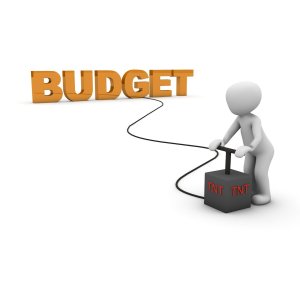
White cartoon person pushing down dynamite hooked to orange text "budget" in the background; symbolizes "blowing up" the budget cost of self-publishing

When thinking about what kind of marketing and promotions you want to do for your book, consider how you can repurpose free material already at your disposal. Can you use images you already paid for? Can you make use of free stock video and video editing software? Do you have a friend who is willing to give you word-of-mouth promotion to their wide social media following? Of all the ways to reduce the cost to publish a book, this one deserves your attention and a detailed plan. 

Consider the various ways you can market, advertise, and promote your book for free or very little cost. It’s easy to invest thousands into marketing a book and ending up with no sales to show for it; make sure you have a plan, wisely consider all the factors, and have clear criteria for what determines the moment you’ll “pull the plug” and discontinue a potentially draining and ineffective marketing strategy.

Self-Publishing Services Can Reduce the Cost to Publish a Book

I recommend you look into the self-publishing services companies and see which offers the services you want at the price point that works for you. A full self-publishing services company should handle printing, distribution, and maybe some marketing for you. But marketing services can vary greatly as well. So before you spend a dime, take the time to do the research and craft a plan that lets you minimize your effort and maximize your results once it’s time to publish.

Conclusion: Results > The Cost to Self-Publish a Book

For you, “results” could mean a sense of accomplishment, checking an item off your bucket list, or the thrill of seeing your name on the cover of your very own hard work. No matter what the cost to self-publish a book is, if it’s the right choice for you, you’ll be willing to pay what it costs to bring your dream into the world.

Got more questions for the editor about the cost of self-publishing your book?


Discover more from SRD Editing Services | Cortni L. Merritt, MA | Orlando Florida

Subscribe to get the latest posts sent to your email.

Leave a Reply

This site uses Akismet to reduce spam. Learn how your comment data is processed.